

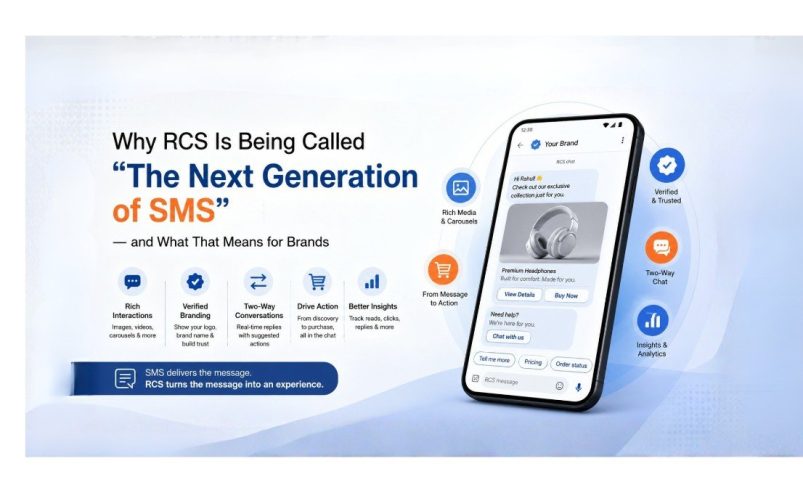
Summary – RCS, or Rich Communication Services, is often called the next generation of SMS because it combines the familiarity and reach of traditional text messaging with richer media, branded sender profiles, interactive buttons, carousels, suggested replies, analytics and two-way conversations. For brands, this means SMS can evolve from a simple notification channel into a more interactive customer engagement and conversion channel. RCS for Business is available on supported Android and iOS devices, with availability depending on carriers and regions.
RCS stands for Rich Communication Services. It is a modern messaging standard designed to provide capabilities that traditional SMS and MMS cannot easily deliver.
Think about a typical SMS from a business. It might say:
“Your order #45821 has been shipped. Track it here: example.com”
The customer receives the information, but the experience is mostly text and a link.
Now imagine the same notification as an RCS message containing the brand’s verified name and logo, a product image, delivery status, a “Track Order” button and a suggested reply such as “Need Help?”
That is the fundamental difference.
SMS primarily delivers information. RCS can turn that information into an interactive customer experience.
Google describes RCS for Business as supporting rich cards, carousels, suggested replies and actions, high-resolution media, verified business profiles, analytics and user-initiated conversations.
This is why RCS is increasingly positioned as the next generation of SMS rather than simply another messaging channel.
How Has SMS Evolved Into RCS?
SMS remains one of the most familiar communication channels, particularly for OTPs, alerts, reminders and short notifications. However, customer expectations have changed.
People now regularly interact with brands through visual and conversational platforms. They expect to see products, select options, ask questions and take actions without unnecessary steps.
Traditional SMS has several limitations:
- Primarily text-based communication
- Limited visual branding
- Minimal interactivity
- Basic customer journeys
- Limited engagement signals
- Dependence on external links for many actions
RCS addresses many of these limitations while maintaining the familiar messaging experience.
The goal isn’t necessarily to eliminate SMS overnight. Instead, RCS gives businesses another way to make messaging more useful, visual and conversational.
RCS vs SMS: What Is the Difference?
|
Feature |
SMS |
RCS |
|
Text messages |
Yes |
Yes |
|
Images and rich media |
Limited |
Yes |
|
Rich cards |
No |
Yes |
|
Carousels |
No |
Yes |
|
Suggested replies |
No |
Yes |
|
Interactive actions |
Limited |
Yes |
|
Verified business profile |
No |
Yes |
|
Read receipts |
Limited |
Yes |
|
Two-way conversations |
Limited |
Yes |
|
Advanced analytics |
Limited |
Yes |
|
Product discovery |
No |
Yes |
|
SMS fallback |
Native |
Supported where configured |
RCS for Business can automatically fall back to SMS/MMS when an RCS message cannot be delivered, helping businesses maintain communication continuity.
That fallback is particularly important for brands that don’t want a campaign to depend entirely on RCS availability.
What RCS Features Make It Different From Traditional SMS?
1. Rich Media Messaging
RCS allows businesses to communicate using high-resolution images, videos, GIFs, audio and other supported rich content.
For example, an online fashion retailer can send a new collection with product images instead of describing everything through text.
A travel company can showcase a hotel, destination images and booking options in a single conversation.
The result is a message that feels much closer to a digital experience than a traditional text alert.
2. Rich Cards and Carousels
Rich cards combine visual content, text and suggested actions.
Carousels go one step further by allowing customers to browse multiple products or services within the conversation.
For example, a real estate company could display:
- 2BHK apartment
- 3BHK apartment
- Luxury villa
- Commercial property
Each option can include an image, price information and a relevant CTA such as “View Property” or “Book a Visit.”
3. Interactive Buttons and Suggested Replies
With SMS, a customer often needs to click a link and navigate somewhere else.
RCS can provide actions such as:
- Buy Now
- Track Order
- Book Appointment
- Find a Store
- Call Us
- View Details
- Talk to Support
Suggested replies can also help customers respond quickly.
This reduces friction and can shorten the path from message to action.
4. Verified Business Identity
Trust is critical when customers receive business messages.
RCS for Business supports verified sender profiles that can display business branding, including the company name, logo and verification indicators.
For banks, e-commerce companies, healthcare providers and other businesses handling sensitive customer interactions, recognizable branding can make communications easier to identify.
5. Two-Way Conversations
RCS can move businesses beyond one-way notifications.
A customer could receive:
“Your appointment is tomorrow at 11:00 AM. Would you like to confirm?”
Then select:
Confirm | Reschedule | Contact Support
This is much more useful than sending a basic reminder and asking the customer to find a phone number or website independently.
Google also supports user-initiated conversations, including entry points that can allow customers to start conversations after finding a business through Google surfaces.
6. Better Analytics
RCS for Business can provide engagement information such as clicks, taps, read receipts and replies.
For marketers, this creates an opportunity to test:
- Which CTA receives more interaction?
- Which product image gets more attention?
- Which offer generates more replies?
- Which customer journey produces more conversions?
That data can help businesses continuously improve messaging campaigns.
How Can Brands Use RCS for Marketing?
RCS can make promotional communication more visual and interactive.
Consider an Indian e-commerce brand launching a festive sale. Instead of sending:
“Diwali Sale: Get up to 50% off. Shop now: example.com”
the brand could create a branded RCS experience featuring product images, offer details, a carousel of categories and direct CTAs.
The same concept can work for:
- Retail promotions
- Restaurant offers
- Travel deals
- Real estate listings
- Education admissions
- Financial products
- Automotive campaigns
The important principle is to use RCS to make the customer journey easier—not simply to add more visual content.
How Can Businesses Use RCS for Transactional Messages?
RCS is not limited to marketing.
Businesses can use rich messaging for:
- Order confirmations
- Shipping updates
- Delivery tracking
- Appointment reminders
- Booking confirmations
- Payment notifications
- OTP and authentication flows
- Customer support
- Returns and exchanges
For example, a logistics company could send a delivery update with the order number, delivery status, estimated arrival time and a “Track Shipment” button.
This makes the notification more actionable.
Which Industries Can Benefit From RCS?
E-commerce
Product recommendations, abandoned-cart communication, order updates and delivery tracking.
Banking and Fintech
Transaction alerts, authentication, fraud notifications and customer support.
Healthcare
Appointment reminders, confirmations and patient communication.
Travel and Hospitality
Booking confirmations, itinerary updates, check-in reminders and customer assistance.
Education
Admission updates, application notifications, fee reminders and event communication.
Real Estate
Property recommendations, lead follow-ups and site-visit scheduling.
Retail
Promotions, loyalty communication, product discovery and personalized offers.
For businesses operating in India, RCS can be particularly relevant because mobile messaging is already deeply integrated into customer communication. However, brands should plan campaigns around carrier, platform and regional availability rather than assuming every recipient will receive the exact same RCS experience.
RCS vs WhatsApp: Should Brands Choose One?
This is not necessarily an either-or decision.
RCS is valuable when a brand wants rich communication through the native messaging environment, while WhatsApp Business can be useful when customers already engage with the brand through WhatsApp.
A practical omnichannel strategy may combine:
RCS + SMS + WhatsApp + Voice + Email + CRM
The right channel depends on the customer, message type, consent, geography and business objective.
For example, an Indian retailer might use RCS for visually rich promotions, SMS for broad fallback communication and WhatsApp for ongoing customer support.
Is RCS Better Than SMS for Businesses?
For interactive and visually rich customer communication, RCS can offer capabilities that traditional SMS does not.
However, it would be misleading to say RCS makes SMS obsolete.
SMS still has an important role because of its simplicity and broad compatibility.
A practical strategy is:
- Use RCS for rich, interactive experiences.
- Use SMS where basic reach and compatibility are priorities.
- Use fallback where supported.
- Measure performance by customer action rather than message volume.
This approach allows brands to modernize messaging without abandoning established communication channels.
What Are the Limitations of RCS?
RCS also has practical considerations.
Availability depends on supported devices, carriers and regions. Features and limits can also vary by platform and carrier.
For businesses targeting India, there are additional promotional messaging rules. Google currently applies reputation-based traffic limits to promotional RCS for Business agents operating in India, including limits on initial messages and unique users. Businesses can also initiate conversations only during specified communication hours.
Therefore, brands should work with an experienced RCS service provider and confirm current regional requirements before launching large-scale campaigns.
How Can a Brand Get Started With RCS?
A practical implementation process looks like this:
- Define the objective — marketing, transactional messaging, support or lead generation.
- Identify the audience — understand where RCS is available to your target customers.
- Choose an RCS service provider — businesses generally work with a partner or messaging aggregator.
- Create and verify the business profile.
- Design rich cards, carousels and CTAs.
- Connect CRM, e-commerce or backend systems where necessary.
- Test different devices and customer journeys.
- Plan fallback communication.
- Launch with relevant, permission-based messaging.
- Track engagement and optimize campaigns.
For Indian businesses, testing is especially important before scaling promotional traffic because RCS business rules and reputation requirements can affect campaign reach.
RCS Best Practices Brands Should Follow
To get meaningful results from RCS, avoid treating it as traditional SMS with extra graphics.
Instead:
- Keep the message focused.
- Use high-quality but relevant visuals.
- Give customers one clear next action.
- Personalize when useful.
- Avoid excessive promotional messaging.
- Make conversations easy to navigate.
- Connect messaging with CRM and customer-service workflows.
- Monitor clicks, reads and replies.
- Test fallback experiences.
- Follow applicable privacy, consent and messaging regulations.
The best RCS campaign is not necessarily the one with the most features. It is the one that removes friction from the customer’s next step.
What Does the Rise of RCS Mean for Brands?
The bigger change is not simply technical.
RCS represents a shift from message delivery to customer interaction.
Traditional SMS might tell a customer that an order has shipped. RCS can potentially let that customer see the shipment status, select an action and continue the conversation.
A promotional SMS can announce a sale. RCS can allow the customer to browse products and take action directly from the messaging experience.
That difference matters because every unnecessary step can create customer drop-off.
For brands, RCS therefore represents an opportunity to rethink the role of mobile messaging—from a notification channel into a measurable customer engagement channel.
Ready to Move Beyond Traditional SMS?
If your business is still using SMS primarily for one-way alerts and promotional messages, RCS gives you an opportunity to build more interactive customer journeys without forcing customers into a completely separate communication environment.
Start by identifying one high-value use case—such as order tracking, lead generation, appointment booking, product promotion or customer support—and test how an interactive RCS experience can improve the customer journey.
For businesses targeting customers across India, choosing the right RCS service provider is equally important. Look for a provider that can support business verification, API integration, analytics, campaign management, fallback strategies and compliance requirements.
If you’re planning to adopt RCS Business Messaging, speak with an experienced RCS provider to evaluate your use case, audience, integrations and rollout strategy before launching at scale.
Frequently Asked Questions
Is RCS really the next generation of SMS?
Yes. RCS is commonly described this way because it extends traditional messaging with rich media, interactive elements, branded profiles, analytics and conversational capabilities. It is designed to provide a richer experience than SMS/MMS.
Can RCS replace SMS completely?
Not necessarily. RCS availability depends on device, carrier and region, so SMS remains important for compatibility and fallback communication.
Does RCS require customers to download an app?
RCS is designed to work through supported native messaging experiences rather than requiring customers to download a separate messaging app. Availability still depends on device and carrier support.
Can businesses use RCS for marketing?
Yes. RCS for Business supports marketing and promotional messaging, including rich media, carousels, personalized offers and interactive actions.
Is RCS available in India?
RCS is available in India, but business messaging availability, features and promotional rules depend on the applicable platform, carrier and current business policies. Google currently has specific promotional traffic rules for RCS for Business agents in India.
What is the main benefit of RCS for brands?
The biggest benefit is the ability to combine familiar mobile messaging with richer, branded and interactive customer experiences.