
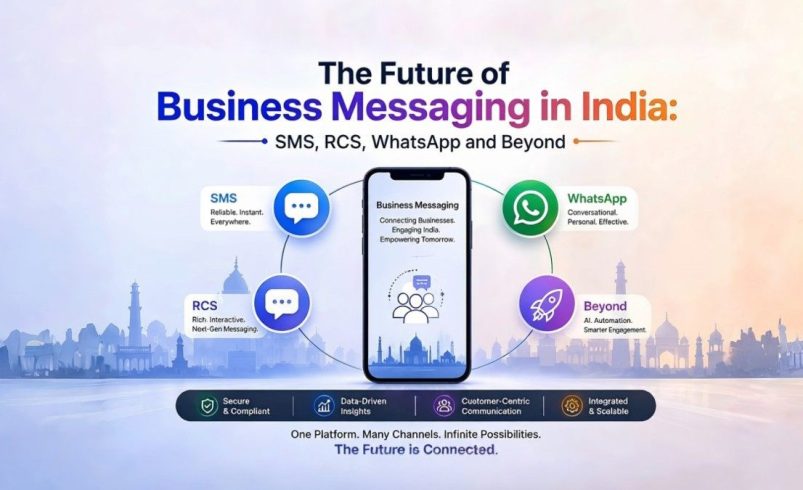
Summary – The future of business messaging in India will not be about replacing SMS with RCS or WhatsApp. Instead, businesses will combine SMS for reliable alerts and OTPs, RCS for rich interactive experiences, WhatsApp for conversations, and AI for automation and personalization. The strongest strategy will be an omnichannel approach connected through APIs, CRM systems and CPaaS platforms.
Business communication in India has moved far beyond sending a simple promotional SMS. Customers now expect order updates, appointment reminders, payment alerts, support and offers to reach them quickly—and increasingly, they expect to respond within the same conversation.
That shift is creating a new messaging ecosystem built around SMS, RCS, WhatsApp Business, AI chatbots, voice automation and CPaaS platforms.
For an e-commerce company in Mumbai, a bank serving customers across India, or a healthcare provider in Pune or Bengaluru, the question is no longer simply, “Should we use SMS or WhatsApp?” The better question is: Which channel should we use at each stage of the customer journey?
How Is Business Messaging Evolving in India?
Traditional SMS remains an important communication channel because it works across a huge range of mobile devices and does not depend on a customer having an internet messaging app.
Businesses continue to use SMS for:
- OTP authentication
- Transaction alerts
- Delivery notifications
- Appointment reminders
- Payment reminders
- Service updates
- Critical security notifications
At the same time, customers increasingly interact with brands through richer channels such as WhatsApp and RCS.
This means business messaging is moving from one-way notification to two-way conversation.
For example, a logistics company might send an SMS when a shipment is dispatched, use RCS to provide a richer tracking experience where supported, and use WhatsApp for customer questions. The channels work together rather than compete.
Will SMS Still Matter in the Future?
Yes. SMS will remain important, particularly for OTPs, transactional communication, alerts and situations where maximum reach and reliability are priorities.
One reason is regulatory maturity. In India, businesses sending bulk commercial communication through telecom resources must comply with the applicable TRAI framework, including Principal Entity registration, header and content-template requirements, and consent processes where applicable.
This makes compliance part of the messaging strategy—not an afterthought.
For example, a financial services company cannot simply upload a customer database and start sending promotional SMS. It needs the appropriate registration, templates and consent mechanisms required for its communication.
For businesses operating across Delhi, Mumbai, Hyderabad, Chennai, Ahmedabad or smaller Tier-2 and Tier-3 markets, SMS can also remain valuable when the objective is dependable communication at scale.
Where Will SMS Perform Best?
SMS is particularly suitable for:
- OTP SMS services
- Banking and transaction alerts
- Delivery notifications
- Service reminders
- Security alerts
- Time-sensitive updates
The future of SMS, therefore, is less about flashy features and more about reach, reliability, compliance and critical communication.
What Is RCS and Why Is It Important for Businesses?
RCS, or Rich Communication Services, upgrades traditional text messaging with richer, interactive experiences.
Instead of receiving:
“Your order has been shipped. Track: example.com”
a customer can potentially receive a branded conversation containing images, rich cards, suggested actions and interactive options.
Google’s RCS for Business platform supports rich media, branding, verification, analytics and interactive customer conversations.
Businesses can use RCS for:
- Product recommendations
- Promotional campaigns
- Order tracking
- Booking confirmations for travel businesses
- Customer suLead generation pport
- Rich product catalogues
- Interactive offers
For example, an online retailer could send a customer a rich card showing a product image, price and action buttons instead of relying on a plain text message.
RCS also supports fallback approaches. Google’s documentation explains that when a user’s device does not support RCS, businesses can use another technology such as SMS.
That makes RCS particularly interesting as part of an omnichannel messaging strategy, rather than as an immediate replacement for SMS.
How Will WhatsApp Business Shape Customer Communication?
WhatsApp has become a natural communication environment for many Indian consumers, making it especially valuable for conversational business communication.
Unlike traditional SMS, WhatsApp can support an ongoing conversation where customers ask questions, share information and receive responses.
Businesses can use WhatsApp Business messaging for:
- Lead generation
- Customer support
- Order confirmations
- Delivery updates
- Appointment booking
- Payment reminders
- Product discovery
- Customer feedback
Consider a real-estate company in Gurugram.
Instead of sending several disconnected messages to a prospective buyer, it can use WhatsApp to share property information, answer initial questions through automation, schedule a site visit and hand the conversation to a sales representative when human assistance is needed.
That is the major shift: messaging becomes part of the sales and service journey rather than simply a notification tool.
SMS vs RCS vs WhatsApp: Which Is Better?
There is no single winner.
|
Channel |
Best For |
Main Strength |
|
SMS |
OTPs, alerts, notifications |
Reach and reliability |
|
RCS |
Rich campaigns and interactive journeys |
Rich media and branding |
|
|
Support, sales and conversations |
Two-way engagement |
|
Voice |
Urgent or complex communication |
Human-like attention |
|
AI Chatbots |
Automated support and lead qualification |
24/7 automation |
The smartest businesses will choose channels according to customer intent.
Someone requesting an OTP does not need a product carousel. A customer comparing products may benefit from RCS or WhatsApp. Someone waiting for a critical delivery update may simply need a concise SMS.
Why Will Omnichannel Messaging Become the Future?
Omnichannel messaging means connecting multiple communication channels into one coordinated customer journey.
Imagine this sequence:
Order placed → WhatsApp confirmation → RCS product/order update → SMS delivery alert → WhatsApp support → AI chatbot → feedback request
The customer experiences one journey, even though several communication technologies are working behind the scenes.
This approach can help businesses improve communication reliability, reduce unnecessary messages and provide customers with the channel most appropriate to their situation.
For Indian businesses serving customers across multiple regions, this is particularly useful because communication preferences can differ between customer groups, industries and locations.
How Will AI Change Business Messaging?
AI is likely to be one of the biggest changes in business communication.
An AI chatbot can answer routine questions, qualify leads, provide order information and route complex issues to human agents.
For example, a healthcare provider could automate:
“What are your consultation timings?”
“How can I reschedule my appointment?”
“Where is your clinic located?”
Instead of requiring a call-centre employee to answer every repetitive question, an AI system can handle common requests and escalate sensitive or complicated cases.
AI can also improve personalization by using customer context to determine:
- What message should be sent
- Which channel should be used
- When the message should be delivered
- Whether a follow-up is necessary
- When a human agent should intervene
The future is therefore moving toward AI-assisted conversations rather than basic automated messages.
How AI Chatbots on WhatsApp Increase Sales & Reduce Support Costs: A Complete Guide for Modern Businesses
Will Vernacular Messaging Become More Important in India?
Absolutely.
India’s market is multilingual, and businesses targeting customers beyond major metros need to consider regional communication preferences.
A campaign designed for an English-speaking urban audience may not produce the same response in smaller cities.
AI-powered translation, multilingual chatbots and regional-language voice communication can help businesses create more accessible experiences across Hindi, Marathi, Tamil, Telugu, Bengali and other Indian languages.
For businesses targeting customers in Maharashtra, for example, combining English and Marathi communication where appropriate can make customer interactions feel more natural.
The goal should not be to translate everything mechanically. The message should sound natural for the audience receiving it.
What About Privacy, Consent and Messaging Compliance?
As business messaging grows, responsible communication will become increasingly important.
For SMS in India, businesses need to pay attention to DLT processes, sender registration, headers, content templates and applicable consent requirements. TRAI states that commercial communication requires registered headers and that relevant consent must be acquired through the prescribed framework.
RCS platforms also have their own policy requirements around accurate business identity, user consent, opt-outs and responsible handling of communication.
The practical lesson is simple:
Do not treat compliance as a technical checkbox. Build consent, preference management and message governance into the communication strategy from the beginning.
Which Industries Will Benefit Most?
The opportunities extend across almost every customer-facing industry.
Banking and BFSI
OTP authentication, transaction alerts, KYC communication, fraud alerts and payment reminders.
E-commerce and Retail
Order updates, product recommendations, abandoned-cart communication and promotional offers.
Healthcare
Appointment reminders, test notifications, patient support and follow-ups.
Education
Admission enquiries, student alerts, fee reminders and examination communication.
Real Estate
Lead nurturing, property recommendations, site-visit reminders and sales follow-ups.
Travel and Hospitality
Booking confirmations, itinerary updates, check-in reminders and customer support.
Logistics
Shipment notifications, delivery tracking, COD reminders and customer communication.
How Can Businesses Prepare for the Future of Messaging?
Businesses do not need to adopt every technology at once. A practical roadmap is:
- Map your customer journey and identify every communication touchpoint.
- Use SMS for critical and high-reach communication.
- Introduce WhatsApp for conversations and customer support.
- Experiment with RCS for rich and interactive experiences.
- Connect messaging channels with CRM and business APIs.
- Businesses can also work with a CPaaS services provider in India to integrate SMS, RCS, WhatsApp, voice, APIs and automation into a more coordinated communication infrastructure.
- Use AI for repetitive support and lead qualification.
- Add voice automation where conversations require immediate attention.
- Track delivery, engagement and conversion—not just message volume.
- Build compliance and consent management into every campaign.
- Continuously test which channel works best for each customer journey.
The Next Step for Indian Businesses
The future of business messaging is not SMS vs RCS vs WhatsApp. It is about knowing when to use SMS, when to start a WhatsApp conversation, when RCS can create a richer experience, and when AI or voice should take over.
Businesses that build this strategy now can create communication journeys that are faster, more personalized and easier to scale.
If your business is planning to upgrade its customer communication, start by mapping your most important use cases—OTP, transactional SMS, customer support, lead follow-up, promotions, delivery updates and automated conversations. Then evaluate the right combination of SMS, RCS, WhatsApp, AI and CPaaS instead of investing in a channel simply because it is trending.
Frequently Asked Questions
Will RCS replace SMS in India?
No. RCS is better suited to rich and interactive experiences, while SMS remains valuable for reach, OTPs and critical notifications. RCS can also use SMS fallback in supported implementations.
Is WhatsApp better than SMS for business communication?
Not universally. WhatsApp is generally stronger for conversations and customer support, while SMS remains useful for high-reach alerts, OTPs and notifications.
What is the future of business messaging in India?
The future is likely to be omnichannel and AI-assisted, combining SMS, RCS, WhatsApp, voice and automation rather than depending on a single channel.
Why should businesses use CPaaS?
A CPaaS platform can help businesses connect communication channels, APIs, automation, analytics and customer systems through a centralized infrastructure.
Is RCS useful for Indian businesses?
Yes. RCS can provide branded, interactive messaging experiences, including rich cards and media. Google also provides brand verification and launch processes for RCS for Business agents.