



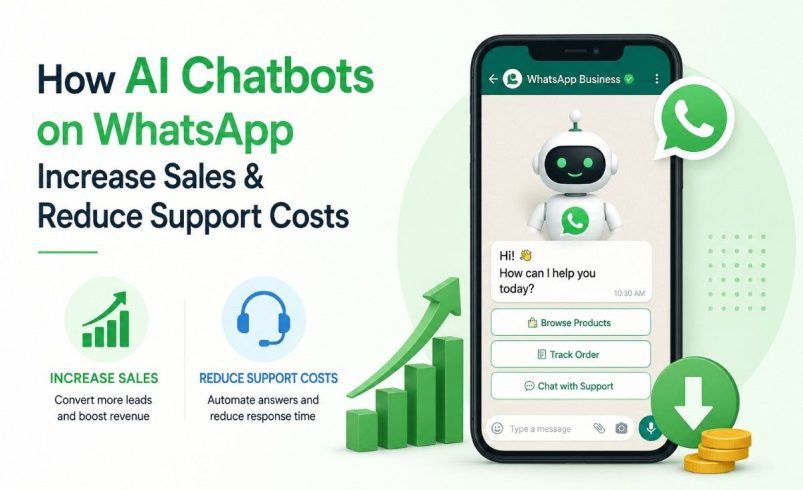
Summary – AI chatbots on WhatsApp help businesses automate customer conversations, qualify leads, provide instant support, and personalize interactions 24/7. By combining artificial intelligence with the WhatsApp Business Platform, businesses can increase sales, reduce customer support costs, improve customer satisfaction, and scale communication without expanding support teams.
Customers expect businesses to respond within minutes—not hours. Whether they’re asking about a product, tracking an order, booking an appointment, or requesting a quote, fast and accurate responses directly influence buying decisions.
Meeting these expectations using only human support teams can be expensive and difficult to scale. That’s why businesses of all sizes are turning to AI-powered WhatsApp chatbots.
With billions of active users worldwide, WhatsApp has become one of the most preferred communication channels for customer engagement. AI chatbots enable businesses to respond instantly, automate routine conversations, capture leads, and assist customers around the clock.
From eCommerce stores and healthcare providers to educational institutions, banks, travel agencies, and real estate companies, organizations across India are using AI chatbots to improve customer experience while reducing operational costs.
This guide explains how WhatsApp AI chatbots work, why businesses are adopting them, and how they contribute to higher sales and more efficient customer support.
What Is an AI Chatbot on WhatsApp?
A WhatsApp AI chatbot is an intelligent virtual assistant that communicates with customers through the WhatsApp Business Platform. Unlike traditional rule-based chatbots, AI chatbots use Natural Language Processing (NLP) and machine learning to understand customer intent and deliver natural, human-like responses.
For example, customers may ask:
- Where is my order?
- Can you track my shipment?
- Has my parcel been dispatched?
Although the wording differs, the chatbot understands the same intent and provides the correct response instantly.
Modern AI chatbots can also:
- Answer FAQs
- Recommend products
- Schedule appointments
- Capture customer details
- Qualify sales leads
- Process service requests
- Transfer complex queries to human agents
When integrated with CRM software, payment gateways, inventory systems, and business applications, they become an extension of both the sales and customer support teams.
How Do AI Chatbots Work on WhatsApp?
Behind every conversation, AI performs several actions within seconds.
Step 1: Customer Sends a Message
Customers initiate conversations by asking questions, requesting information, or enquiring about products or services.
Step 2: AI Understands the Request
Using NLP, the chatbot identifies the customer’s intent instead of searching for exact keywords.
Step 3: Business Information Is Retrieved
The chatbot securely accesses information from systems such as:
- CRM platforms
- Product catalogues
- Knowledge bases
- Order management software
- Appointment scheduling tools
Step 4: Instant Response
The chatbot provides a personalized reply based on customer history and available business information.
Step 5: Human Escalation
If a query requires personal assistance, the chatbot transfers the conversation to a support executive along with the complete chat history.
This combination of automation and human support delivers faster, smoother customer experiences.
Why Are Businesses Adopting AI Chatbots on WhatsApp?
Businesses are expected to provide faster service without significantly increasing operational costs. AI chatbots help achieve both objectives.
Customers Want Immediate Responses
Quick replies improve customer satisfaction and increase the likelihood of converting enquiries into sales. Even a short delay can result in lost opportunities.
Support Costs Are Increasing
Growing businesses often struggle with rising support expenses. AI chatbots automate repetitive enquiries, allowing support teams to focus on more valuable customer interactions.
Higher Conversation Volumes
Promotional campaigns, festive sales, admission seasons, and product launches generate thousands of enquiries. AI chatbots manage these conversations simultaneously without affecting response times.
Personalized Customer Experience
Today’s customers expect businesses to remember previous conversations and provide relevant recommendations. AI chatbots use available customer information to deliver more personalized interactions.
Scalable Business Growth
Instead of continuously hiring new support staff, businesses can automate routine communication while maintaining consistent service quality.
How AI Chatbots on WhatsApp Increase Sales?
While many businesses initially implement AI chatbots to automate customer support, they soon realize these virtual assistants also play an important role in increasing revenue. From engaging new enquiries to recovering abandoned carts, AI chatbots help move customers smoothly through the buying journey.
1. Respond to Leads Instantly
When a potential customer contacts your business, every minute matters. Delayed responses often result in lost opportunities, especially in competitive industries.
A WhatsApp AI chatbot instantly welcomes new enquiries, answers basic questions, shares product information, and collects customer details without waiting for a sales executive.
Example:
A real estate company in Pune receives enquiries through digital advertising campaigns. Instead of asking customers to wait for office hours, the chatbot immediately shares project brochures, pricing, location maps, and books site visits. This quick engagement significantly improves lead conversion rates.
2. Qualify Leads Automatically
Not every enquiry is sales-ready. AI chatbots help identify qualified prospects by asking relevant questions such as:
- Budget
- Preferred location
- Product interest
- Business requirements
- Purchase timeline
By collecting this information automatically, sales teams can focus on high-intent prospects instead of manually filtering every enquiry.
3. Recommend Relevant Products
AI chatbots analyze customer preferences and previous interactions to recommend suitable products or services.
For example, an online clothing store can suggest matching accessories after a customer selects an outfit, while an electronics retailer may recommend compatible accessories, extended warranties, or upgraded models.
These personalized recommendations improve customer experience and increase the average order value.
4. Recover Abandoned Carts
Many online shoppers leave without completing their purchase.
A WhatsApp AI chatbot can automatically send friendly reminders, answer last-minute questions, and share limited-time offers to encourage customers to complete their orders.
Even a simple follow-up message can recover valuable sales that might otherwise be lost.
5. Automate Follow-ups
Following up consistently is essential for converting leads, but doing it manually consumes valuable time.
AI chatbots automatically send:
- Quotation reminders
- Appointment confirmations
- Demo invitations
- Renewal notifications
- Product follow-ups
Because these messages are timely and personalized, they feel helpful rather than intrusive.
6. Deliver 24/7 Customer Assistance
Unlike human teams, AI chatbots never go offline.
Customers browsing products late at night or during weekends can still receive pricing information, product recommendations, delivery timelines, and answers to common questions. Continuous availability helps businesses capture sales opportunities outside normal business hours.
How AI Chatbots Reduce Customer Support Costs?
Modern AI Chatbot Software helps businesses reduce customer support costs by automating repetitive conversations while allowing human agents to focus on high-value interactions. Instead of replacing support teams, it improves efficiency by handling routine enquiries quickly and accurately.
Answer Frequently Asked Questions
Many customer queries are repetitive, including:
- Order tracking
- Delivery updates
- Business hours
- Pricing
- Return policies
- Appointment availability
Instead of assigning these requests to support agents, AI chatbots provide instant responses, reducing workload and improving customer satisfaction.
Manage Large Volumes of Conversations
Customer enquiry volumes often increase during festive sales, product launches, admissions, and promotional campaigns.
Unlike human teams, AI chatbots can manage thousands of conversations simultaneously without affecting response quality or speed.
This allows businesses to scale customer communication without significantly increasing operational costs.
Reduce Resolution Time
Customers appreciate quick answers.
By accessing CRM systems, knowledge bases, and order management platforms, AI chatbots retrieve accurate information within seconds. Faster responses lead to improved customer experiences and lower support costs.
Allow Support Teams to Focus on Complex Issues
AI chatbots handle routine conversations, while human agents focus on complaints, technical issues, relationship management, and high-value customer interactions.
This balanced approach improves efficiency without sacrificing customer experience.
Industries Successfully Using WhatsApp AI Chatbots
AI-powered WhatsApp chatbots are transforming customer communication across multiple industries.
|
Industry |
Common Use Cases |
|
E-commerce |
Product recommendations, order tracking, cart recovery |
|
Healthcare |
Appointment booking, patient support, reminders |
|
Education |
Admission enquiries, counselling, fee information |
|
Real Estate |
Property recommendations, brochure sharing, site visit booking |
|
Banking & Finance |
Loan enquiries, account assistance, customer verification |
|
Travel & Hospitality |
Booking updates, travel assistance, itinerary sharing |
|
Insurance |
Policy renewals, claim status, customer support |
|
Logistics |
Shipment tracking and delivery notifications |
These industries benefit from faster responses, reduced workloads, and improved customer satisfaction.
Real-World Business Examples
E-commerce
During festive shopping seasons, online retailers often experience a surge in customer enquiries about product availability, payment methods, and delivery timelines.
Instead of expanding support teams temporarily, businesses use WhatsApp AI chatbots to answer common questions, recommend products, and guide customers through the purchase process. Human agents only handle complex requests, helping businesses improve efficiency while increasing conversions.
Education
Colleges and universities receive thousands of admission-related enquiries every year. AI chatbots help automate brochure sharing, eligibility information, counselling registrations, and application updates, allowing admission teams to focus on prospective students who require personalized guidance.
Healthcare
Hospitals and clinics use AI chatbots to schedule appointments, send reminders, answer frequently asked questions, and provide basic healthcare information. This reduces administrative workload while improving the patient experience.
Key Features to Look for in a WhatsApp AI Chatbot
Choosing the right AI chatbot is just as important as deciding to automate customer communication. A feature-rich solution delivers better customer experiences and long-term business value.
Look for these essential capabilities:
- Natural Language Processing (NLP) for understanding customer intent.
- Multilingual Support to engage customers in regional and global languages.
- CRM Integration for personalized conversations using customer data.
- Human Agent Handover for complex queries requiring personal assistance.
- Rich Media Support to share images, videos, PDFs, product catalogues, and interactive buttons.
- Analytics & Reporting to measure engagement, response times, and conversions.
- Workflow Automation for lead capture, appointment scheduling, reminders, and follow-ups.
- API Integrations with ERP, payment gateways, helpdesk platforms, and inventory systems.
Selecting a chatbot with these capabilities ensures it supports both sales and customer service as your business grows.
AI Chatbot vs Traditional Customer Support
While AI chatbots are highly effective, they work best alongside human support teams rather than replacing them.
|
Feature |
AI Chatbot |
Traditional Support |
|
Availability |
24/7 |
Business hours |
|
Response Time |
Instant |
Depends on agent availability |
|
Scalability |
Handles thousands of chats |
Limited by team size |
|
Operating Cost |
Lower |
Higher staffing costs |
|
Routine Queries |
Automated |
Manual |
|
Complex Issues |
Escalates to agents |
Handled directly |
The most successful businesses combine AI automation with experienced support teams to deliver faster responses without compromising service quality.
Best Practices for Implementing a WhatsApp AI Chatbot
Deploying an AI chatbot is only the first step. To achieve measurable business results, follow these best practices:
- Define clear business goals before implementation.
- Train the chatbot using real customer questions and FAQs.
- Keep conversations simple, natural, and customer-focused.
- Integrate the chatbot with CRM and business applications.
- Regularly review chatbot analytics and customer feedback.
- Provide an easy option to connect with a live support agent.
- Continuously update chatbot knowledge as products and services evolve.
These practices help improve customer satisfaction while maximizing automation efficiency.
Common Mistakes to Avoid
Many chatbot projects fail because businesses overlook customer experience. Avoid these common mistakes:
- Automating every conversation without offering human assistance.
- Using repetitive or robotic responses.
- Ignoring chatbot performance reports and customer feedback.
- Failing to update product information and FAQs.
- Not integrating the chatbot with existing business systems.
- Creating long and confusing conversation flows.
Keeping conversations simple and customer-centric leads to better engagement and higher satisfaction.
The Future of AI Chatbots on WhatsApp
AI-powered customer communication is evolving rapidly. Over the next few years, businesses can expect WhatsApp AI chatbots to offer:
- More natural conversations using Generative AI.
- Voice-enabled AI assistants.
- Predictive customer support based on customer behaviour.
- Hyper-personalized product recommendations.
- Omnichannel engagement across WhatsApp, websites, email, and social media.
- AI-powered sales assistants capable of managing complete buying journeys.
Businesses that adopt these innovations early will be better positioned to improve customer engagement, increase efficiency, and stay ahead of competitors.
Turn Every WhatsApp Conversation into a Business Opportunity
Customers expect fast, personalized, and convenient communication. Businesses that respond quickly are more likely to build trust, convert enquiries into customers, and strengthen long-term relationships. A well-designed AI chatbot on WhatsApp helps automate routine conversations, qualify leads, provide 24/7 support, and improve operational efficiency without sacrificing customer experience.
Whether your business operates in Mumbai, Delhi, Bengaluru, Hyderabad, Chennai, Pune, Ahmedabad, Kolkata, Jaipur, Surat, or anywhere else in India, combining AI Chatbot Software with the WhatsApp Business Platform, RCS Service Provider solutions, SMS Notification Service, Transactional SMS Service, OTP SMS Service, Voice OTP Delivery Services, SMPP Server Service, Bulk SMS Reseller Services, Promotional Voice Calls Service, Bulk Voice Calling Service, Transactional Voice Calls Reseller, Outbound Voice Calls services, Missed Call Services, Toll-free number provider, and DLT Registration can help you create a scalable and connected customer communication strategy.
If you’re looking to increase sales, automate customer engagement, and reduce support costs, now is the right time to explore AI-powered communication solutions tailored to your business. The right strategy can help you deliver better customer experiences, improve operational efficiency, and drive sustainable business growth.
Frequently Asked Questions
Can AI chatbots on WhatsApp increase sales?
Yes. They engage customers instantly, qualify leads, recommend products, automate follow-ups, and recover abandoned carts, helping businesses improve conversion rates.
Are WhatsApp AI chatbots suitable for small businesses?
Absolutely. They automate customer communication, reduce response times, and provide professional support without requiring large customer service teams.
Can AI chatbots replace human support agents?
No. AI chatbots are designed to handle routine conversations while transferring complex or sensitive issues to human representatives.
Which industries benefit the most from WhatsApp AI chatbots?
Industries such as eCommerce, healthcare, education, banking, real estate, travel, logistics, insurance, hospitality, and professional services can all improve customer engagement through AI-powered automation.
Can WhatsApp AI chatbots integrate with CRM software?
Yes. Most modern AI chatbot solutions integrate with CRM platforms, payment gateways, ERP systems, inventory software, and helpdesk applications to deliver personalized customer experiences.