

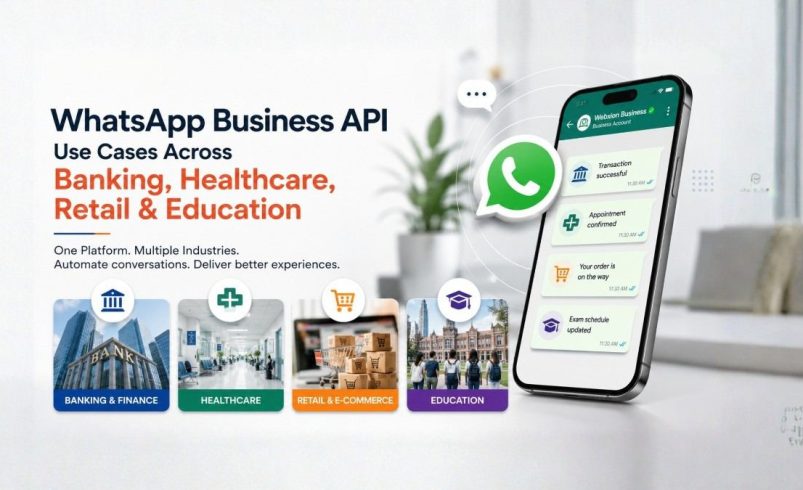
Summary – WhatsApp Business API helps banks, healthcare providers, retailers, and educational institutions automate customer communication through notifications, authentication, support, lead generation, reminders, and two-way conversations. By connecting WhatsApp with CRM, ERP, payment, booking, and customer-support systems, businesses can deliver faster, more personalized communication at scale.
The WhatsApp Business API, now part of the WhatsApp Business Platform, enables organizations to communicate with customers through automated and two-way WhatsApp conversations at scale. Unlike the regular WhatsApp Business App, the API is designed for businesses that need integrations, automation, multiple workflows, chatbots, notifications, and structured customer communication.
For example, a bank can send a transaction alert, a hospital can remind a patient about an appointment, an online retailer can share an order-tracking update, and a college can notify students about admission deadlines—all through WhatsApp.
The real advantage is not simply sending messages. It is connecting WhatsApp with existing business systems so that communication happens automatically when a customer performs an action.
Why Is WhatsApp Business API Important for Different Industries?
Customers increasingly expect businesses to communicate through channels they already use regularly. WhatsApp provides a familiar environment for receiving information, asking questions, sharing documents, and continuing conversations.
Businesses can use the platform for:
- Customer notifications and reminders
- OTP and authentication workflows
- Lead generation and qualification
- Customer support
- Appointment scheduling
- Order and delivery updates
- Payment reminders
- Promotional communication
- Chatbot automation
- CRM and ERP integration
- Personalized customer journeys
The most effective strategy is to connect WhatsApp communication with a specific business objective rather than treating it as another bulk messaging channel.
How Do Banks Use WhatsApp Business API?
Banking is one of the strongest use cases because customers require fast, reliable communication about financial activities.
1. Account Opening and Customer Onboarding
Banks can use WhatsApp to communicate application confirmations, onboarding instructions, document requirements, and account-opening status.
Instead of requiring customers to repeatedly check a website or call support, the bank can proactively provide relevant updates.
2. KYC and Document Reminders
WhatsApp can support KYC-related communication by sending reminders about pending documentation, verification status, or required actions.
For example, a customer who has started an account-opening process but has not completed documentation can receive a timely reminder.
3. Transaction and Payment Alerts
Banks and financial institutions can send notifications for:
- Debit and credit transactions
- Fund transfers
- Payment confirmations
- Failed transactions
- Card activity
- Account-related alerts
These notifications improve transparency while reducing unnecessary calls to customer support.
4. Loan and EMI Communication
Financial institutions can automate loan application updates, EMI reminders, payment confirmations, and disbursement notifications.
A conversational workflow can also allow customers to request information or connect with a support representative.
5. Customer Support and Banking FAQs
A WhatsApp chatbot can answer common questions about products, services, application processes, branch information, and other routine queries before transferring complex cases to a human agent.
Practical insight: For banking, WhatsApp should complement—not replace—secure banking systems. Sensitive financial workflows require appropriate authentication, consent, privacy controls, and secure integrations.
How Can Healthcare Providers Use WhatsApp Business API?
Healthcare organizations can use WhatsApp to improve patient communication before, during, and after an appointment.
1. Appointment Booking and Reminders
Hospitals, clinics, diagnostic centers, and doctors can use WhatsApp Business API for appointment enquiries, confirmations, reminders, cancellations, and rescheduling.
A simple reminder can help reduce missed appointments and unnecessary administrative follow-ups.
2. Diagnostic Report Notifications
Patients can receive notifications when diagnostic reports become available or when a test reaches a particular stage in the workflow.
3. Follow-Up and Medication Reminders
Healthcare providers can use approved communication workflows for follow-up appointments, treatment reminders, and other appropriate patient communications.
4. Patient Support and FAQs
A healthcare chatbot can answer routine questions such as:
- What are the hospital timings?
- Which department should I contact?
- How can I book an appointment?
- What services are available?
- How can I reschedule my appointment?
Complex or sensitive questions should be escalated to qualified staff.
5. Feedback and Patient Experience
After a consultation or service, healthcare organizations can request feedback and identify recurring service issues.
Important: Healthcare communication requires particular attention to consent, privacy, data handling, and applicable regulations. Businesses should avoid assuming that a WhatsApp workflow is automatically compliant simply because it uses an official platform.
How Can Hospitals Use WhatsApp Business API to Improve Patient Communication?
How Does Retail Use WhatsApp Business API?
Retail and e-commerce businesses can use WhatsApp throughout the customer journey, from product discovery to post-purchase support.
1. Product Discovery and Enquiries
Businesses can share product information, images, catalogues, recommendations, and answers to customer questions.
This is particularly useful when customers want clarification before purchasing.
2. Order Confirmation and Payment Updates
After an order is placed, WhatsApp can automatically communicate order confirmation, payment status, invoice information, and other relevant updates.
3. Shipping and Delivery Notifications
Retailers can notify customers when an order is dispatched, out for delivery, or delivered.
For Indian e-commerce businesses, this can be especially valuable during high-volume periods such as Diwali, Dussehra, Eid, Christmas, and major online shopping campaigns, when customers expect frequent order updates.
4. Abandoned Cart Recovery
Where permitted by WhatsApp’s messaging policies and customer consent, businesses can use personalized conversations to remind shoppers about abandoned products and encourage them to complete a purchase.
5. Customer Support and Returns
Customers can use WhatsApp to ask about:
- Order status
- Returns
- Refunds
- Product availability
- Delivery problems
- Warranty information
Connecting WhatsApp with an e-commerce platform and CRM can make these workflows significantly more efficient.
How Can Educational Institutions Use WhatsApp Business API?
Schools, colleges, universities, coaching institutes, and EdTech companies can use WhatsApp throughout the student lifecycle.
1. Student Lead Generation
Education providers can connect advertisements, landing pages, QR codes, and websites to WhatsApp. Prospective students can immediately ask about courses, fees, eligibility, locations, and admission dates.
2. Admission and Application Updates
Institutions can send application confirmations, document reminders, counselling updates, interview schedules, and increase admission.
3. Fee Reminders and Payment Communication
WhatsApp can help institutions communicate fee due dates, payment confirmations, installment reminders, and scholarship-related updates.
4. Exam, Class, and Result Notifications
Students can receive timetable changes, examination reminders, result notifications, assignment deadlines, and other important academic updates.
5. Parent Communication
Educational institutions can use structured WhatsApp notifications for attendance alerts, important announcements, event information, and parent communication.
For Indian institutions, multilingual communication can also be valuable because students and parents may prefer English, Hindi, Marathi, Tamil, Telugu, Bengali, or other regional languages depending on location.
WhatsApp Business API vs SMS: Which Is Better?
The answer depends on the communication objective.
WhatsApp Business API is generally stronger when a business needs rich media, two-way conversations, interactive messages, chatbots, customer support, or CRM integration.
SMS remains useful for concise alerts, broad reach, and situations where customers may not be actively using WhatsApp.
For many organizations, the practical approach is not WhatsApp vs SMS. A well-designed communication strategy can use WhatsApp, SMS, voice, email, and other channels according to the customer’s situation.
How Does WhatsApp Business API Integration Work?
A typical enterprise workflow looks like this:
Customer → WhatsApp → API → Automation/Chatbot → CRM or Backend System → Response/Agent
For example, an e-commerce customer asks, “Where is my order?” The WhatsApp chatbot can identify the customer’s order, retrieve tracking information from the connected system, and return the current status without requiring an agent to manually search for it.
The same principle can be applied to banking enquiries, healthcare appointments, and education admissions.
What Should Businesses Check Before Choosing a WhatsApp API Provider?
Businesses evaluating a WhatsApp Business API provider in India should look beyond basic message delivery.
Check for:
- Official WhatsApp Business Platform access
- Business verification assistance
- API and CRM integration
- Chatbot and automation capabilities
- Template management
- Delivery and engagement analytics
- Scalability
- Security practices
- Technical support
- Transparent pricing
- API documentation and developer support
A provider should be able to explain not only how to send messages but also how WhatsApp will fit into the company’s existing customer journey.
What Are the Common WhatsApp Business API Mistakes?
Businesses often make the mistake of using WhatsApp only for promotions. That limits its value.
Other common problems include:
- Sending messages without appropriate customer consent
- Overusing promotional communication
- Creating confusing chatbot menus
- Not providing human-agent escalation
- Failing to integrate CRM or backend systems
- Ignoring privacy and industry requirements
- Measuring only message delivery instead of business outcomes
A better strategy is to define the objective first—such as reducing support workload, improving admission enquiries, increasing order visibility, or automating appointment reminders—and then design the WhatsApp workflow around it.
Ready to Build an Industry-Specific WhatsApp Communication Strategy?
Whether you operate a bank, hospital, retail business, educational institution, or growing digital business, the best WhatsApp strategy starts with the customer journey—not the message template.
Identify the conversations that consume the most staff time, the notifications customers repeatedly request, and the points where leads or customers drop off. Then connect those workflows with WhatsApp Business Platform, automation, CRM integration, and human support where needed.
If you are looking for a WhatsApp Business API provider in India, discuss your specific use case, expected message volume, integrations, compliance requirements, and automation goals
What is WhatsApp Business API mainly used for?
It is used for automated notifications, authentication, customer support, lead generation, marketing communication, reminders, commerce, and two-way business conversations.
How do banks use WhatsApp Business API?
Banks can use it for onboarding, KYC communication, transaction alerts, loan updates, payment reminders, customer support, and other approved customer-service workflows.
Can hospitals use WhatsApp Business API for appointments?
Yes. Healthcare organizations can use WhatsApp for appointment enquiries, confirmations, reminders, rescheduling, follow-ups, and routine patient support, subject to applicable policies and privacy requirements.
How does WhatsApp help retail businesses?
Retailers can use WhatsApp for product enquiries, order confirmations, delivery updates, customer support, promotions, cart recovery, and conversational commerce.
Can colleges use WhatsApp Business API for admissions?
Yes. Colleges can use WhatsApp to manage admission enquiries, application updates, document reminders, counselling communication, fee notifications, and student support.
Can WhatsApp Business API integrate with a CRM?
Yes. API-based integrations can connect WhatsApp conversations with CRM, ERP, helpdesk, payment, booking, e-commerce, and other backend systems.with an experienced provider before implementation. A properly planned WhatsApp solution can turn routine communication into a faster, measurable, and more useful customer experience.