


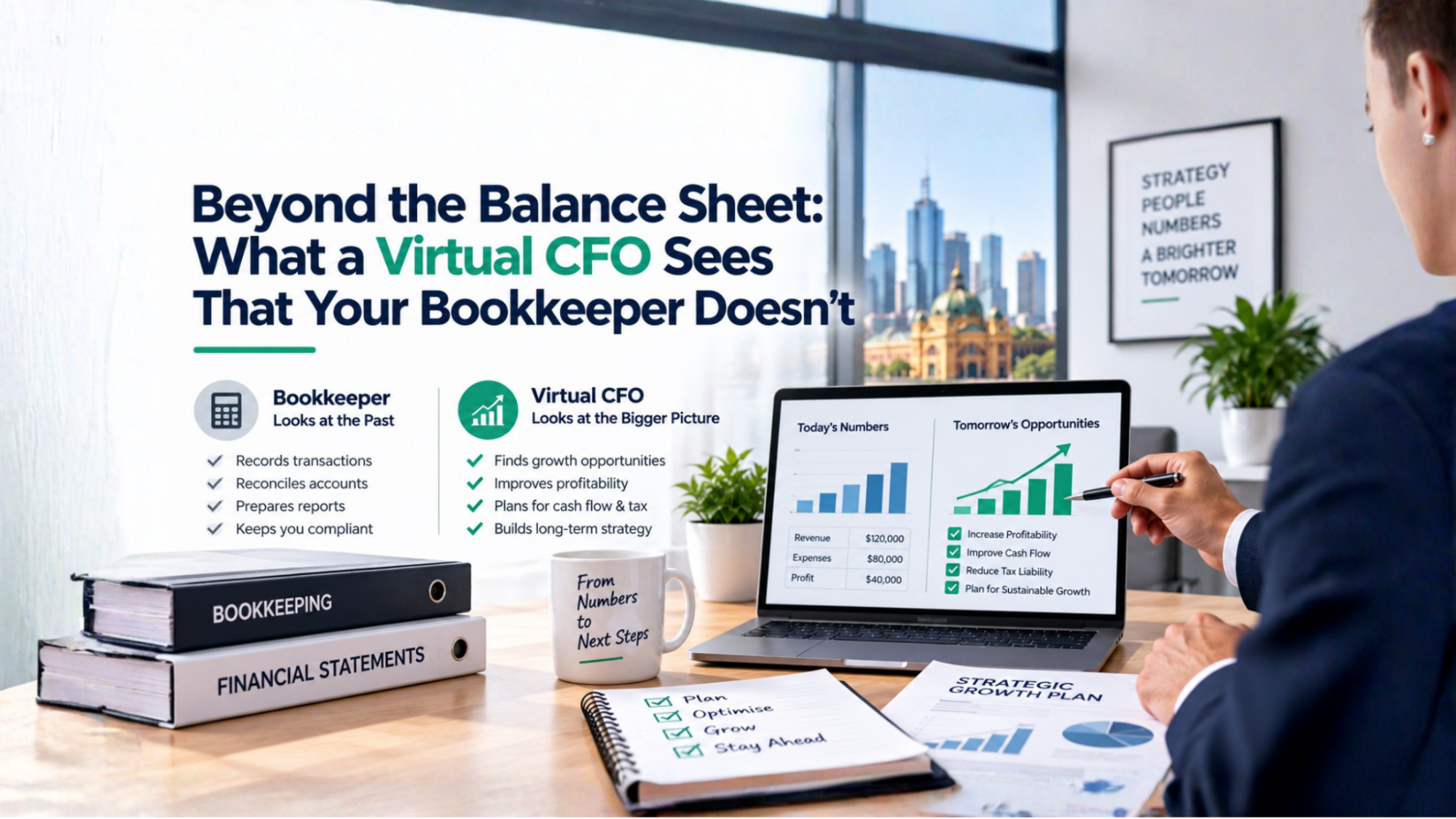
Summary – A bookkeeper tells you what has happened financially. A Virtual CFO helps you understand why it happened, what could happen next, and what your business should consider doing about it. While bookkeeping is essential for accurate financial records, growing businesses often need deeper financial analysis, cash-flow forecasting, profitability insights, risk management and strategic planning. This is where Virtual CFO services can add another layer of financial expertise.
For Australian businesses in Melbourne, Sydney and other major business markets, the difference becomes particularly important as revenue grows, operations become more complex and financial decisions carry greater consequences.
What Is the Difference Between a Bookkeeper and a Virtual CFO?
A bookkeeper primarily records and maintains financial transactions. A Virtual CFO takes financial information and uses it to support business planning and decision-making.
A bookkeeper may answer:
“How much did the business spend last month?”
A Virtual CFO may ask:
“Why did expenses increase, how will this affect margins over the next six months, and can the business maintain its current growth rate?”
Both roles are valuable, but they operate at different levels.
|
Area |
Bookkeeper |
Virtual CFO |
|
Transaction recording |
Yes |
Reviews |
|
Reconciliations |
Yes |
Reviews |
|
Accounts payable/receivable |
Yes |
Analyses |
|
Financial reporting |
Supports |
Interprets |
|
Budgeting |
Sometimes |
Yes |
|
Cash-flow forecasting |
Limited |
Yes |
|
Financial modelling |
Rarely |
Yes |
|
KPI analysis |
Limited |
Yes |
|
Risk assessment |
Limited |
Yes |
|
Strategic financial planning |
No/limited |
Yes |
|
Growth planning |
No/limited |
Yes |
A Virtual CFO does not replace a bookkeeper. Instead, the CFO-level function often builds on accurate bookkeeping and accounting information.
What Does a Virtual CFO See Beyond the Balance Sheet?
1. Cash-Flow Problems Before They Become a Crisis
One of the biggest misconceptions in business is that profitability automatically means strong cash flow.
A business can report a profit while having very little cash available.
For example, imagine a professional services company in Melbourne invoices $200,000 during a quarter. Its accounting records show strong revenue and a healthy profit. However, several major customers have 60-day payment terms, while salaries, rent, software subscriptions and suppliers must be paid much earlier.
The business may be profitable on paper but under pressure in its bank account.
A Virtual CFO examines:
- Accounts receivable
- Accounts payable
- Payment cycles
- Working capital
- Upcoming commitments
- Cash reserves
- Expected cash inflows and outflows
The objective is not simply to report the current cash position. It is to identify potential cash shortages before they disrupt operations.
2. Where Your Business Is Actually Making Money
Revenue alone does not tell you which parts of your business are profitable.
A Virtual CFO can analyse profitability by:
- Product
- Service
- Customer
- Location
- Business division
- Project
- Sales channel
Consider a Sydney-based consultancy with three service lines. One generates the highest revenue but requires significant staff time and has relatively low margins. Another generates less revenue but produces substantially better margins.
Looking only at total revenue could lead management toward the wrong growth strategy.
A Virtual CFO asks a more useful question:
“Which revenue is creating the greatest sustainable contribution to the business?”
That distinction can influence pricing, resource allocation, sales strategy and future investment.
3. Hidden Cost and Margin Problems
Costs rarely become a problem overnight.
They often increase gradually:
- Supplier prices rise
- Salaries increase
- Software subscriptions accumulate
- Marketing costs expand
- Rent and operating expenses increase
- Contractors become more expensive
If revenue grows at 8% but operating expenses increase by 15%, the business may appear to be growing while profitability is quietly deteriorating.
A Virtual CFO monitors relationships between revenue, gross profit, operating expenses and net profit.
This helps management identify whether growth is actually translating into stronger financial performance.
4. Financial Trends That Monthly Reports May Not Explain
Traditional financial statements are essential, but simply receiving a monthly report does not necessarily provide financial insight.
A Virtual CFO looks for trends such as:
- Declining gross margins
- Increasing debtor days
- Rising customer concentration
- Slowing revenue growth
- Increasing overheads
- Seasonal cash-flow pressures
- Changes in operating efficiency
For example, a business might notice that revenue has increased every quarter. A deeper analysis could reveal that the growth is coming from a small number of customers.
That creates a different financial risk.
If one customer represents a significant percentage of total revenue, losing that account could have a material impact on cash flow and profitability.
5. Working Capital and Cash Conversion
Working capital is another area where CFO-level analysis can reveal problems that aren’t immediately obvious.
A Virtual CFO may examine:
- How quickly customers pay
- How long inventory remains unsold
- How quickly suppliers need to be paid
- How much cash is tied up in operations
- The business’s cash conversion cycle
Improving these areas can sometimes release cash without requiring additional borrowing or investment.
For an expanding Australian SME, this can be particularly valuable because growth itself can consume cash. More sales may mean more staff, inventory, equipment, suppliers and operating expenses before customers actually pay.
6. Financial Risks Business Owners May Not See
Business owners naturally focus on sales, customers and operations. Financial risk can sometimes receive less attention until a problem appears.
A Virtual CFO can help identify risks involving:
- Customer concentration
- Debt obligations
- Cash reserves
- Tax liabilities
- Large upcoming expenses
- Unprofitable contracts
- Excessive overheads
- Dependence on one revenue stream
The objective is to understand the financial consequences before making major decisions.
How Does a Virtual CFO Turn Financial Data Into Business Decisions?
The real value of CFO-level support comes from connecting financial information with business decisions.
From Historical Reports to Forecasts
Financial statements explain what has already happened.
Forecasting asks what could happen next.
A Virtual CFO can develop rolling forecasts covering:
- Revenue
- Expenses
- Cash flow
- Profitability
- Working capital
- Funding requirements
Scenario modelling can then examine different assumptions.
Base case: Revenue continues at the current growth rate.
Upside case: Sales increase faster than expected.
Downside case: Revenue falls and customer payments slow.
This gives management a clearer framework for preparing for different circumstances.
From Revenue Growth to Profitable Growth
A business does not necessarily become financially healthier simply because sales increase.
A Virtual CFO considers:
Revenue → Gross Margin → Operating Costs → EBITDA → Net Profit → Cash Flow
This creates a more complete picture of business performance.
The question changes from “How can we increase sales?” to:
“How can we increase sustainable, profitable and cash-generating revenue?”
What Questions Does a Virtual CFO Ask?
A CFO-level review may raise questions such as:
- Why is revenue increasing while cash is falling?
- Which customers generate the highest margins?
- Which services are least profitable?
- What happens if sales decline by 20%?
- Can the business afford five additional employees?
- How much cash should be retained as a reserve?
- When will a new location break even?
- Is the current pricing structure sustainable?
- How much debt can the business reasonably support?
- Which expenses are growing faster than revenue?
These questions turn accounting information into management intelligence.
When Should a Business Hire a Virtual CFO?
A Virtual CFO can become particularly useful when a business experiences:
- Rapid growth
- Increasing financial complexity
- Cash-flow uncertainty
- Multiple revenue streams
- Expansion plans
- Significant hiring
- New investment requirements
- Acquisition or sale discussions
- Increasing debt
- Lack of reliable management reporting
You may also need CFO-level support when the business owner is spending too much time trying to understand financial information instead of using it to make decisions.
Do Small Businesses Need a Virtual CFO?
Not every small business requires CFO-level support.
However, the need is often determined more by financial complexity than business size.
A growing SME may benefit from Virtual CFO services when financial decisions become too complex for basic bookkeeping and routine accounting alone.
This is one reason outsourced or fractional CFO models can be attractive. Businesses can access senior financial expertise without necessarily employing a full-time CFO.
Virtual CFO vs Accountant vs Bookkeeper
These roles can work together rather than compete.
Bookkeeper: Maintains accurate financial records.
Accountant: Supports accounting, taxation, compliance and financial reporting.
Virtual CFO: Uses financial information for forecasting, performance analysis, risk management and strategic decision-making.
For a growing Australian business, having these functions work together can create a stronger financial management process.
Need Greater Visibility Into Your Business Finances?
Your bookkeeping tells you what has already happened. The next step is understanding what those numbers mean for cash flow, profitability, risk and future growth.
If your business is growing in Melbourne, Sydney or elsewhere in Australia, consider whether your current financial reporting gives you enough information to make confident decisions about hiring, expansion, pricing, investment and cash management.
Speak with a qualified Virtual CFO services in Melbourne or financial advisory professional to review your current financial reporting, identify the gaps and build a forward-looking financial strategy around your business goals.
Frequently Asked Questions
What does a Virtual CFO do that a bookkeeper doesn't?
A Virtual CFO analyses financial information, develops forecasts, monitors financial performance, identifies risks and provides strategic financial guidance. A bookkeeper primarily records and maintains financial transactions.
Is a Virtual CFO suitable for small businesses?
Yes, particularly when a small or medium-sized business is growing, managing complex finances, experiencing cash-flow challenges or making significant investment and expansion decisions.
Can a Virtual CFO work with my existing bookkeeper?
Yes. A Virtual CFO can use bookkeeping and accounting information as the foundation for financial analysis, forecasting and strategic planning.
How can a Virtual CFO improve cash flow?
A Virtual CFO can analyse receivables, payment terms, expenses, working capital and future cash requirements to identify potential pressure points and develop cash-flow strategies.
What reports does a Virtual CFO provide?
Depending on the business, reporting may include management accounts, cash-flow forecasts, budgets, KPI dashboards, profitability analysis, financial models and scenario forecasts.
Is a Virtual CFO the same as an accountant?
No. Accountants and Virtual CFOs can both work with financial information, but CFO services generally focus more heavily on forward-looking analysis, financial strategy, business performance and decision support.