



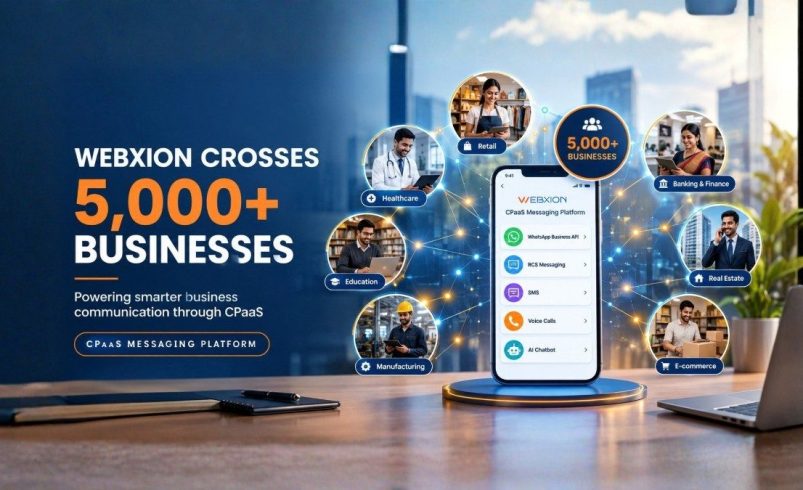
Summary – WebXion has crossed the 5,000+ business milestone on its CPaaS messaging platform, reflecting the growing demand for integrated business communication in India. With communication channels such as WhatsApp Business API, RCS, SMS, voice calling, missed calls and AI chatbots becoming increasingly important, CPaaS platforms are helping businesses connect customer communication with automation, APIs and everyday business workflows.
A customer journey can involve several communication channels in just a few minutes.
An OTP may arrive through SMS. A purchase confirmation may come through WhatsApp. A delivery update may appear as an RCS message. A customer might then interact with a chatbot before speaking to a support executive.
For businesses, managing these interactions separately can quickly become complicated.
That is one reason CPaaS Provider in India has become an increasingly relevant search for businesses looking to simplify communication infrastructure.
WebXion recently reached a significant milestone of 5,000+ clients while continuing to provide CPaaS-based communication solutions across India. The company says it has more than 16 years of experience and serves sectors including banking, insurance, real estate, education, healthcare, manufacturing, retail and government.
What Does Crossing 5,000+ Businesses Mean for CPaaS?
The milestone is more than a customer number. It also reflects how business communication is moving away from isolated messaging tools toward connected communication platforms.
Traditional communication often required separate systems for SMS, voice calls, customer support and messaging.
CPaaS changes that model by bringing communication capabilities together through cloud infrastructure and APIs.
A business can connect its CRM, website, mobile application or internal software with communication services and trigger messages automatically.
For example, when an online customer completes a payment, the business could automatically trigger:
- A payment confirmation
- An SMS notification
- A WhatsApp update
- A delivery notification
- A support message if the transaction requires attention
The exact workflow depends on the business and its technology stack, but the principle is simple: communication becomes part of the business process rather than a separate activity.
Why Are Businesses Looking for CPaaS Providers in India?
Indian businesses operate across different industries, customer segments and geographic markets. A single communication channel is rarely suitable for every situation.
A bank may need OTP and transaction messaging.
A hospital may need appointment reminders and patient notifications.
An e-commerce company may need order updates and customer support.
A manufacturer may need communication with dealers and distributors.
A real estate company may need lead alerts, follow-ups and appointment reminders.
This creates demand for a Top 10 CPaaS provider in India that can support multiple communication requirements through one connected infrastructure.
Modern CPaaS platforms can combine services such as:
- WhatsApp Business API
- SMS Services
- OTP messaging
- RCS Business Messaging
- Outbound voice calls
- Missed call services
- IVR services
- AI chatbots
- API and CRM integrations
- Communication analytics
WebXion currently lists WhatsApp Official API, RCS, SMS, voice, missed call and AI chatbot services among its CPaaS offerings.
How Does a CPaaS Messaging Platform Work?
At a basic level, CPaaS connects software applications with communication services through APIs.
Consider an example from healthcare.
A patient books an appointment through a hospital website.
The booking system sends the information to the communication platform through an API. The CPaaS workflow then sends an appointment confirmation and may trigger a reminder closer to the scheduled time.
If the patient needs assistance, a WhatsApp chatbot or support workflow can handle the initial interaction.
The hospital does not need employees to manually send every confirmation and reminder.
This is where CPaaS becomes more than a messaging service. It becomes part of the company’s operational infrastructure.
Which Communication Channels Are Driving CPaaS Adoption?
WhatsApp Business API
WhatsApp is widely used for customer conversations, notifications, lead management and support.
Businesses can use the official WhatsApp Business Platform for structured communication, automation and two-way conversations, subject to applicable WhatsApp policies and requirements. WebXion states that its WhatsApp offering includes API integration, automation, CRM integration and customer communication workflows.
WhatsApp Business API: Complete Guide for Business Messaging in 2026
SMS and OTP
SMS remains important for time-sensitive communication.
OTP verification, transaction alerts, booking confirmations and security notifications are common examples.
For businesses, reliability matters because an undelivered authentication message can directly affect the customer journey.
How Businesses Use Transactional SMS for Alerts and Notifications?
RCS Business Messaging
RCS provides richer messaging capabilities than traditional SMS where supported.
Businesses can use features such as images, buttons, carousels and branded messaging to create more interactive customer communication. WebXion’s RCS platform describes these capabilities along with delivery and engagement reporting.
Voice and Missed Calls
Not every customer interaction works well through text.
Voice communication can be useful for reminders, notifications, campaigns and automated calling workflows.
Missed call services can also provide a simple way for customers to respond to campaigns, request callbacks or register interest without requiring an app or lengthy form.
AI Chatbots
AI chatbots add another layer to CPaaS by helping businesses automate frequently asked questions, lead qualification and initial customer support.
WebXion’s AI chatbot offering supports website, WhatsApp and voice-based interactions, along with CRM/API integrations and automated workflows.
What Makes CPaaS Useful for Different Industries?
The value of CPaaS becomes clearer when viewed through actual business situations.
Banking and insurance: OTPs, transaction alerts, payment reminders, policy updates and customer support.
Healthcare: appointment confirmations, reminders, patient notifications and support communication.
Education: admission enquiries, fee reminders, class notifications and student communication.
Retail and e-commerce: order confirmations, shipping updates, promotional communication and customer support.
Real estate: lead notifications, property enquiries, site-visit reminders and sales follow-ups.
Manufacturing: dealer communication, dispatch updates, service notifications and B2B customer engagement.
This flexibility is one reason CPaaS is becoming relevant to businesses of different sizes rather than only large enterprises.
Why Does API Integration Matters More Than Just Messaging?
One of the most important differences between a basic messaging tool and a CPaaS platform is integration.
A business may already have a CRM, ERP, website, mobile application or e-commerce system. Communication becomes more useful when these systems can exchange information with the CPaaS platform.
For example:
Website enquiry → CRM entry → WhatsApp acknowledgement → Sales notification → Automated follow-up
Instead of treating each activity separately, businesses can create a connected workflow.
For growing companies, this can reduce repetitive manual tasks and give customer-facing teams better visibility into communication history.
What Should Businesses Look for in a CPaaS Provider in India?
Reaching a large customer base does not automatically make every CPaaS platform suitable for every business.
Businesses should evaluate providers based on their actual requirements.
Look at:
- Available channels – Does the provider support WhatsApp, SMS, RCS, voice and other required services?
- API capabilities – Are APIs, webhooks and documentation available for your technology stack?
- Scalability – Can the platform handle your current and expected communication volume?
- Reporting – Can teams monitor delivery, failures and communication activity?
- Integration support – Can it connect with CRM, ERP, websites and applications?
- Security and compliance – Does the provider follow the relevant platform, telecom and data requirements?
- Technical support – Is assistance available during onboarding, integration and troubleshooting?
Pricing is important, but it should not be the only deciding factor. A communication failure can cost more than a small difference in message pricing.
What Could the Next Phase of CPaaS Look Like?
The next stage of CPaaS is likely to involve deeper automation rather than simply sending more messages.
Businesses are increasingly combining messaging with AI, customer data, CRM systems and workflow automation.
A customer might begin with an SMS notification, continue through WhatsApp, interact with an AI chatbot and eventually be transferred to a human support representative.
This creates an omnichannel customer communication journey.
For Indian businesses, this can be particularly useful when serving customers across different regions, languages and levels of digital adoption.
The role of a CPaaS platform is therefore moving toward communication orchestration—helping businesses determine what should be communicated, through which channel, and at what stage of the customer journey.
What Does WebXion’s 5,000+ Milestone Tell Businesses?
WebXion’s 5,000+ client milestone comes alongside a broader CPaaS offering covering messaging, voice and AI-powered communication. Its current company information highlights 16+ years of experience and services spanning RCS, SMS, Voice, WhatsApp API, AI chatbots and marketing automation.
For businesses evaluating communication technology, the larger takeaway is that CPaaS is increasingly being treated as a business infrastructure layer.
The important question is no longer simply, “How can we send bulk messages?”
It is becoming:
“How can we connect every important customer interaction to the systems and workflows already running our business?”
That shift explains why CPaaS continues to attract attention from startups, SMEs and enterprises across India.
Moving Beyond Messages to Connected Customer Communication
The 5,000+ business milestone highlights a broader change in how companies approach customer communication. Messaging, voice, automation, APIs and AI are increasingly being connected rather than managed as isolated tools.
For businesses evaluating a CPaaS provider in India, the practical starting point is to map existing communication workflows, identify repetitive customer interactions and determine which channels need automation.
From there, businesses can evaluate CPaaS platforms based on integration capabilities, scalability, communication channels, reporting, support and compliance requirements.
If your business is considering WhatsApp API, RCS, SMS, voice communication or AI-powered customer engagement, reviewing your communication architecture now can help identify where CPaaS can create a more connected customer experience.
Frequently Asked Questions
What is a CPaaS messaging platform?
A CPaaS messaging platform is a cloud-based communication system that allows businesses to connect services such as SMS, WhatsApp, RCS, voice and chatbots with websites, applications and business software through APIs.
How many businesses use WebXion's CPaaS platform?
WebXion's current company information states that the company has crossed the 5,000+ client milestone.
Which communication channels can businesses use through CPaaS?
Depending on the provider, businesses can access WhatsApp Business API, SMS, RCS, voice calls, missed calls, IVR, AI chatbots and other communication services through a CPaaS platform.
Why do businesses use a CPaaS provider in India?
Businesses use CPaaS to connect customer communication with automation, APIs, CRM systems and business workflows while managing multiple communication channels through a more unified infrastructure.
Is CPaaS useful for small and medium-sized businesses?
Yes. SMEs can use CPaaS for OTPs, customer notifications, lead follow-ups, appointment reminders, WhatsApp communication, automated support and other workflows without building telecom infrastructure themselves.