



Summary – Transactional SMS helps businesses communicate important updates with customers instantly through automated text messages. From OTP verification and payment confirmations to order updates, delivery alerts, and appointment reminders, companies use transactional SMS to keep customers informed at every important stage.
The biggest advantage of transactional SMS is speed, reliability, and accessibility. Customers do not need an internet connection or a specific app to receive these messages, making SMS one of the most effective communication channels for businesses across industries.
Whether it is a bank sending a transaction alert, an e-commerce company sharing delivery updates, or a healthcare provider reminding patients about appointments, transactional SMS helps businesses create smoother and more trustworthy customer experiences.
What Is Transactional SMS?
Transactional SMS is a business messaging service designed to send important and customer-specific notifications based on a particular action or event.
These messages are usually triggered automatically when a customer interacts with a business system.
Some common examples of transactional SMS include:
- OTP verification messages
- Payment confirmation alerts
- Order confirmation updates
- Delivery status notifications
- Appointment reminders
- Account security alerts
- Invoice and payment receipts
For example, when a customer purchases a product online and receives an order confirmation message, that message is a transactional SMS. Similarly, when a bank sends an alert after a successful transaction, it is also a transactional notification.
The main purpose of transactional SMS is to deliver essential information quickly and ensure customers always stay updated.
Why Do Businesses Use Transactional SMS for Customer Alerts?
Businesses rely on transactional SMS because customers expect quick, clear, and reliable updates. A missing or delayed notification can create confusion and negatively affect customer satisfaction.
Here are some major reasons businesses use transactional SMS:
Instant Delivery of Important Information
Transactional SMS allows businesses to send critical updates within seconds.
Companies use these messages for:
- OTP verification
- Fraud prevention alerts
- Payment confirmations
- Delivery updates
- Service notifications
For example, banks cannot depend only on email for transaction alerts because customers may not check their inbox immediately. SMS provides a direct and faster communication method.
Better Customer Experience Through Proactive Communication
Customers value businesses that keep them informed without making them search for updates.
A simple SMS notification can remove uncertainty and improve the overall customer journey.
Examples:
An online customer receives:
“Your order has been shipped and will arrive tomorrow.”
A patient receives:
“Your appointment is confirmed for 10:30 AM.”
A banking customer receives:
“Your transaction of ₹5,000 has been completed successfully.”
These small updates create confidence because customers know what is happening at every step.
Higher Visibility Compared to Many Other Channels
SMS continues to be a highly effective communication channel because people usually notice text messages quickly.
Unlike emails that may remain unopened or app notifications that require customers to have an installed application, SMS reaches customers directly on their mobile phones.
This makes transactional SMS useful for:
- Mobile-first audiences
- Customers with limited internet access
- Businesses serving customers across different regions
- Companies targeting both urban and rural markets in India
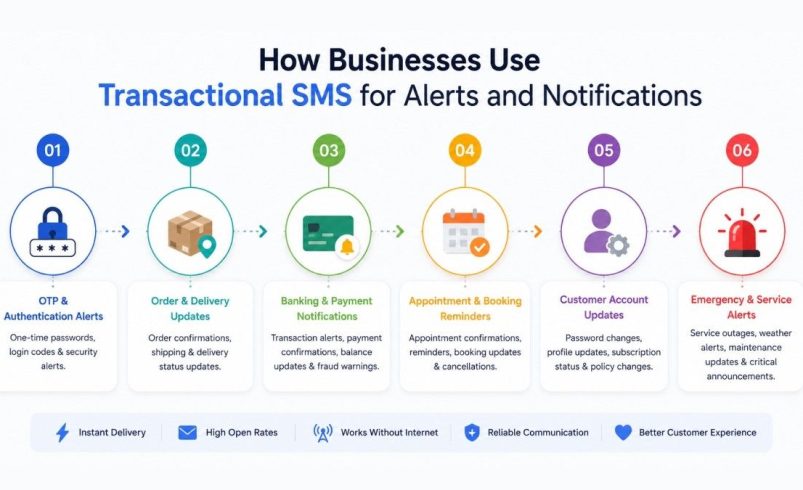
How Businesses Use Transactional SMS for Alerts and Notifications?
OTP and Account Verification Messages
One of the most common uses of transactional SMS is customer authentication.
Businesses use OTP messages for:
- New account registration
- Login verification
- Password recovery
- Two-factor authentication
Banks, fintech companies, online platforms, and SaaS businesses use OTP SMS to protect customer accounts and prevent unauthorized access.
Order Confirmation and E-commerce Notifications
E-commerce businesses use transactional SMS throughout the buying process to keep customers updated.
Common notifications include:
- Order confirmation
- Payment successful message
- Shipment updates
- Delivery tracking
- Order completion alerts
For example, customers shopping online expect to receive updates after placing an order. SMS notifications help businesses maintain transparency and improve customer confidence.
Banking and Financial Transaction Alerts
Financial institutions depend heavily on transactional SMS for secure communication.
Common banking alerts include:
- Debit and credit transaction notifications
- Account activity updates
- Loan payment reminders
- Credit card payment alerts
- Suspicious activity warnings
These messages help customers monitor their accounts and quickly respond to unusual activities.
Healthcare Appointment and Patient Notifications
Healthcare businesses use transactional SMS to improve patient communication and reduce missed appointments.
Examples include:
- Appointment confirmations
- Doctor availability updates
- Test report notifications
- Medicine reminders
Hospitals, clinics, and healthcare providers use automated SMS reminders to improve operational efficiency and provide better patient experiences.
Real Estate Customer Communication
Real estate companies use transactional SMS to manage customer interactions and improve lead communication.
Examples include:
- Property inquiry confirmations
- Site visit reminders
- Booking updates
- Payment notifications
When a customer requests information about a property, an immediate SMS confirmation helps businesses respond faster and improve customer engagement.
Education and Online Learning Notifications
Educational institutions and online learning platforms use transactional SMS for important student communication.
Common uses include:
- Admission updates
- Exam notifications
- Fee reminders
- Course updates
SMS helps educational organizations communicate quickly with students and parents.
How Transactional SMS Works Behind Business Systems?
Transactional SMS works through automation between business software and messaging platforms.
The process usually includes the following steps:
Step 1: Customer Action
A customer completes an activity such as:
- Making a payment
- Placing an order
- Booking an appointment
- Requesting login access
Step 2: Automated System Trigger
The business software identifies the customer activity.
This can happen through:
- CRM platforms
- E-commerce systems
- Banking software
- Mobile applications
Step 3: SMS API Sends the Message
The business system connects with an SMS platform through an API and automatically sends the notification.
Step 4: Customer Receives the SMS
The customer receives the message directly on their mobile phone.
This automation allows businesses to send thousands of notifications without manual effort.
Benefits of Transactional SMS for Businesses
Reduces Manual Communication
Automated SMS notifications reduce the need for employees to manually contact customers.
Businesses save time while maintaining consistent communication.
Builds Customer Trust
When customers receive timely updates, they feel more confident about the business and its services.
Supports Large-Scale Communication
Transactional SMS allows companies to communicate with thousands or millions of customers simultaneously.
It is especially useful for:
- Banks
- E-commerce platforms
- Healthcare networks
- Government services
- Large enterprises
Works Without Internet Access
One of the biggest advantages of SMS is that customers do not need:
- Mobile apps
- Internet connection
- Wi-Fi access
This makes SMS highly effective in regions across India where customers may have different levels of digital access.
Choosing the Right SMS Notifications Service Provider
Choosing the right technology partner is important because customer communication depends on message delivery speed, reliability, and security.
A trusted SMS Notifications Service Provider should offer.
- High message delivery rates
- Secure messaging infrastructure
- SMS API integration
- Real-time delivery tracking
- Scalable communication solutions
- Compliance with telecom regulations including DLT requirements in India
Businesses should carefully evaluate providers based on their reliability, technical support, security standards, and ability to handle communication at scale.
The right SMS partner helps businesses deliver consistent customer experiences across multiple touchpoints.
Transactional SMS vs Email Notifications: Which One Is Better?
Both SMS and email have their own advantages.
Transactional SMS works better for:
- Urgent notifications
- OTP verification
- Time-sensitive updates
- Real-time alerts
Email works better for:
- Detailed information
- Documents
- Long-form communication
Many successful businesses use both channels together to create a complete customer communication strategy.
Best Practices for Sending Transactional SMS
Keep Messages Simple and Clear
Customers should immediately understand why they received the message.
Example:
“Your payment of ₹2,500 was successful. Transaction ID: XXXX.”
Personalize Customer Messages
Adding relevant details improves customer experience.
Businesses can include:
- Customer name
- Order number
- Booking information
- Account details
Send Notifications at the Right Time
Timing plays an important role in communication.
A delivery reminder or appointment alert is only useful when customers receive it at the right moment.
Follow Compliance Guidelines
Businesses should follow messaging regulations, sender ID requirements, and telecom guidelines to maintain reliability and successful delivery.
Future of Transactional SMS in Business Communication
Transactional SMS continues to remain an important part of business communication as companies combine it with newer technologies such as:
- AI-based automation
- CRM platforms
- WhatsApp Business messaging
- RCS messaging
- Omnichannel communication strategies
Businesses are moving toward connected communication systems where SMS works together with other channels to create faster and more personalized customer experiences.
Take the Next Step Toward Better Customer Communication
Transactional SMS helps businesses stay connected with customers at the exact moments that matter. Whether it is confirming an order, securing an account, reminding a patient, or sending a payment update, automated SMS communication improves trust and customer satisfaction.
Businesses that want to improve their notification process should identify where customers need faster updates and choose a reliable communication solution that can support their growth.
A strong transactional SMS strategy can help businesses deliver better experiences, reduce operational effort, and build stronger customer relationships.
Frequently Asked Questions About Transactional SMS
What is transactional SMS used for?
Transactional SMS is used for sending important customer notifications such as OTPs, payment updates, order confirmations, reminders, and security alerts.
Why do businesses use transactional SMS?
Businesses use transactional SMS because it provides instant delivery, high visibility, automation, and reliable customer communication.
Can transactional SMS be automated?
Yes. Businesses can automate SMS notifications by integrating SMS APIs with websites, applications, CRM systems, and business software.
Is transactional SMS useful for small businesses?
Yes. Small businesses can use transactional SMS for appointment reminders, payment updates, customer alerts, and service notifications.
Which industries use transactional SMS?
Banking, healthcare, e-commerce, logistics, education, travel, and real estate businesses commonly use transactional SMS.
How can businesses improve SMS delivery?
Businesses can improve delivery performance by choosing a reliable SMS provider, maintaining customer data accuracy, following compliance rules, and monitoring delivery reports.