



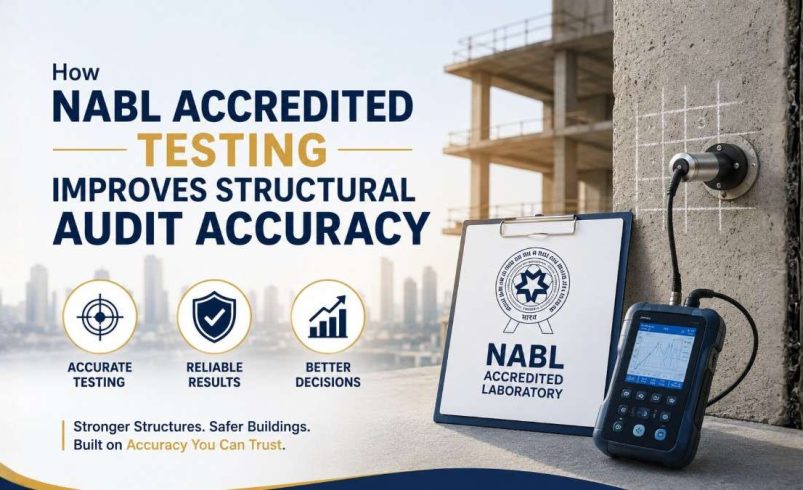
Summary – NABL accredited testing improves structural audit accuracy by providing reliable, standardized, and traceable test results. When concrete strength, reinforcement condition, and other structural parameters are tested by a competent accredited laboratory, structural engineers can make better-informed decisions about safety, repairs, strengthening, and long-term maintenance.
What Is a Structural Audit?
A structural audit is a systematic assessment of an existing building to determine its structural condition, identify defects, and evaluate whether it remains safe for continued use.
A typical audit may include visual inspection, measurements, non-destructive testing (NDT), laboratory testing, review of construction records, and structural analysis. The objective is not simply to find cracks or visible damage. It is to understand why the damage exists, how serious it is, and what action is required.
For example, a crack in a concrete column may appear minor during a visual inspection. However, testing could reveal reduced concrete strength or reinforcement corrosion behind the visible defect. That additional evidence can significantly change the engineer’s recommendation.
This is where reliable construction material testing becomes important.
What Does NABL Accreditation Mean for Structural Testing?
NABL stands for the National Accreditation Board for Testing and Calibration Laboratories. Accreditation indicates that a laboratory has been assessed for technical competence and operates according to recognized quality requirements within its accredited scope.
For structural audits, this matters because engineers often make important decisions based on test results.
An NABL accredited testing laboratory can provide greater confidence that applicable testing procedures, equipment, personnel competence, quality controls, and reporting processes are properly managed.
However, one point is particularly important: a laboratory being NABL accredited does not automatically mean every test it performs is covered by accreditation. The specific test and applicable standard should fall within the laboratory’s accredited scope.
That is something building owners, consultants, contractors, and project managers should verify before commissioning testing.
Why Is Accurate Testing Important for a Structural Audit?
A structural audit combines observation with technical evidence.
Visual inspection can identify:
- Cracks
- Spalling concrete
- Dampness and leakage
- Corrosion stains
- Exposed reinforcement
- Structural deformation
- Deterioration of finishes
But visual inspection alone cannot always determine the actual condition of the material underneath.
Testing can provide additional information about:
- Concrete strength
- Concrete uniformity
- Reinforcement location and cover
- Possible internal defects
- Material deterioration
- Steel properties
- Other relevant structural parameters
The better the test data, the more confidently an engineer can interpret the building’s condition.
This is particularly important for older residential buildings, commercial properties, industrial facilities, schools, hospitals, and structures exposed to demanding environmental conditions.
How Does NABL Accredited Testing Improve Structural Audit Accuracy?
1. Standardized Testing Procedures
Accredited laboratories follow documented testing procedures and applicable standards within their scope.
This helps reduce inconsistencies in how samples are prepared, tested, measured, and reported.
For structural audit work, standardized testing makes results easier for engineers and consultants to interpret and compare.
2. Better Control Over Testing Equipment
Testing equipment must produce dependable measurements. Calibration, maintenance, and equipment control therefore have a direct impact on test reliability.
For example, when testing concrete strength, inaccurate equipment can potentially affect the reported result. Proper equipment management helps minimize this risk.
3. Competent Technical Personnel
Testing is not simply about putting a sample into a machine and recording a number.
Sample preparation, test selection, equipment operation, observations, calculations, and reporting all require technical competence.
An appropriately accredited laboratory provides a structured quality framework for these activities.
4. Improved Sample Traceability
A structural testing program may involve samples collected from different floors, columns, beams, slabs, or other locations.
Proper identification and documentation are essential.
If a concrete core sample is tested, the engineer needs to know where it came from, how it was handled, which test was performed, and what the result represents.
Traceability makes the final structural assessment more defensible.
5. Stronger Quality Control
Quality control helps identify inconsistencies and testing issues before results are used for important engineering decisions.
For building owners, this means the structural engineer can work with a stronger technical evidence base instead of relying on assumptions.
What Tests Are Commonly Used During Structural Audits?
The exact testing program depends on the building’s age, construction type, visible condition, structural system, and audit objectives.
Concrete Strength Testing
Concrete core testing can provide direct information about the in-situ concrete’s strength.
This can be particularly useful when an engineer needs more reliable evidence than surface-level observations can provide.
Non-Destructive Testing
NDT methods are widely used because they can provide useful information without causing significant damage to the structure.
Common techniques include:
- Rebound hammer testing
- Ultrasonic Pulse Velocity (UPV)
- Rebar detection and cover measurement
- Other applicable NDT methods
NDT results should be interpreted properly and, where necessary, correlated with other testing rather than treated as a standalone verdict on structural safety.
Reinforcement and Steel Testing
Where required, steel testing can help determine relevant mechanical or material properties.
This can be important when assessing older structures, alterations, deterioration, or suspected material-quality issues.
Construction Material Testing
Depending on the project, other construction materials may also need testing to understand their condition and performance.
The testing strategy should always be selected based on the structural engineer’s assessment rather than ordering every available test without a clear objective.
NABL Testing vs. Conventional Testing: What Is the Difference?
|
Factor |
NABL Accredited Testing |
Non-Accredited Testing |
|
Testing process |
Defined quality procedures |
May vary by laboratory |
|
Technical competence |
Assessed within accreditation scope |
Requires independent verification |
|
Equipment management |
Controlled within quality system |
Depends on laboratory |
|
Documentation |
Structured and traceable |
May vary |
|
Quality assurance |
Established framework |
Laboratory-dependent |
|
Confidence in results |
Higher confidence when within scope |
Requires additional scrutiny |
The key takeaway is not that every non-accredited test is automatically unreliable. Rather, accreditation provides an additional layer of confidence regarding laboratory competence and quality systems.
Can NABL Accredited Testing Replace a Structural Audit?
No. NABL accredited testing does not replace a structural audit.
Testing and structural auditing serve different purposes.
A structural audit is an overall engineering assessment. Laboratory and NDT results provide technical evidence that helps the structural engineer understand the building’s condition.
A reliable assessment may therefore combine:
Visual inspection + NDT + laboratory testing + engineering analysis + site-specific experience.
This combination is especially valuable when dealing with older or visibly deteriorated buildings.
How Does Testing Help Identify Structural Problems?
Consider an older apartment building in Mumbai with visible concrete cracks and damp patches.
A visual inspection may indicate possible deterioration, but the engineer may need additional information to determine whether the issue is superficial or structurally significant.
NDT could provide information about concrete uniformity, while core testing could help assess in-situ concrete strength. Reinforcement-related investigations could provide additional evidence about corrosion or cover.
The engineer can then interpret these results alongside site observations and structural details.
This approach is more useful than making a major repair decision based solely on the appearance of a crack.
Similar needs can arise in older buildings across Mumbai, Pune, Thane, Navi Mumbai, Bengaluru, Delhi NCR, Ahmedabad, Hyderabad, and Chennai. For property owners seeking Structural Testing and Audit Services in Pune, combining a professional structural inspection with reliable testing can help identify problems early and guide the right repair or strengthening decisions.
When Should a Building Undergo Structural Testing?
Testing may be appropriate when:
- A building is aging
- Significant cracks or spalling are visible
- Reinforcement corrosion is suspected
- There is persistent water leakage
- Major renovation is planned
- Building usage or loading is changing
- Structural damage has occurred after an unexpected event
- A property is being assessed before major investment or redevelopment
- Previous construction quality is uncertain
The testing requirement should be determined according to the building’s condition and the structural engineer’s objectives.
How Can You Choose the Right NABL Accredited Testing Laboratory?
Before appointing a laboratory, don’t stop at the words “NABL accredited.”
Use this practical checklist:
- Verify the laboratory’s current accreditation.
- Check the NABL scope of accreditation.
- Confirm that the specific test you require is covered.
- Ask which standards and test methods will be followed.
- Understand how samples will be collected and identified.
- Ask about equipment calibration and quality control.
- Review the laboratory’s reporting process.
- Ensure test results can be clearly correlated with sample locations.
- Share the structural engineer’s testing requirements with the laboratory.
- Compare technical capability rather than selecting solely on price.
For structural audits, the right laboratory is one that can provide relevant, traceable, technically appropriate testing, not simply the lowest quotation.
What Are the Benefits of NABL Accredited Testing for Building Owners?
For property owners and facility managers, reliable testing can support better decisions about:
- Structural repairs
- Rehabilitation
- Preventive maintenance
- Strengthening requirements
- Material replacement
- Long-term asset management
- Safety-related decisions
It can also reduce uncertainty.
Instead of asking, “Is this crack serious?”, the project team can work toward a more useful question: “What does the available inspection and testing evidence tell us about the actual condition of this structural element?”
That shift from assumption to evidence is one of the biggest advantages of a properly planned testing program.
Make Structural Audit Decisions Based on Reliable Evidence
A structural audit is only as strong as the information supporting its conclusions. Visual inspection identifies what can be seen, while appropriate testing helps reveal what may not be obvious from the surface.
NABL accredited testing adds confidence through standardized procedures, competent testing, controlled equipment, quality assurance, and traceable reporting—when the required test falls within the laboratory’s accredited scope.
If you are planning a structural audit for an existing building, redevelopment project, commercial property, industrial facility, or residential complex, start by identifying the tests actually required by the structural engineer. Then choose a competent NABL accredited construction material testing laboratory that can provide reliable evidence for those specific requirements.
Before approving repairs based on assumptions, get the structure tested, the results documented, and the findings reviewed by qualified structural professionals.
Frequently Asked Questions
What is NABL accredited testing?
NABL accredited testing refers to laboratory testing performed by a laboratory accredited for specific testing activities within its defined scope. It provides greater confidence in the laboratory's technical competence and quality processes.
Is NABL accreditation mandatory for every structural audit?
Not necessarily. The requirements depend on the project, applicable regulations, client requirements, and engineering assessment. However, using an appropriately accredited laboratory can strengthen confidence in important test results.
Is a rebound hammer test enough for a structural audit?
Usually, it should not be treated as the only basis for assessing structural safety. Depending on the situation, engineers may combine NDT with core testing, reinforcement assessment, visual inspection, and structural analysis.
How can I verify an NABL accredited laboratory?
Check the laboratory's accreditation status and, importantly, verify that the specific testing method or activity is included in its current accreditation scope.
Why is concrete testing important in structural audits?
Concrete testing can provide objective information about material properties and condition, helping structural engineers make better-informed decisions about repairs, strengthening, and continued use.