


Summary – PAYG instalments are advance payments towards your expected income tax in Australia. If your business profit or investment income falls, you may be able to vary your instalment amount or rate to better reflect your expected tax liability. The key is to use realistic financial forecasts, follow the ATO’s variation rules and avoid reducing payments so far that you face an unexpected tax bill. Accurate financial records and reliable Accounting and Financial Reporting Services can help you make informed decisions while protecting your business cash flow.
What Are PAYG Instalments in Australia?
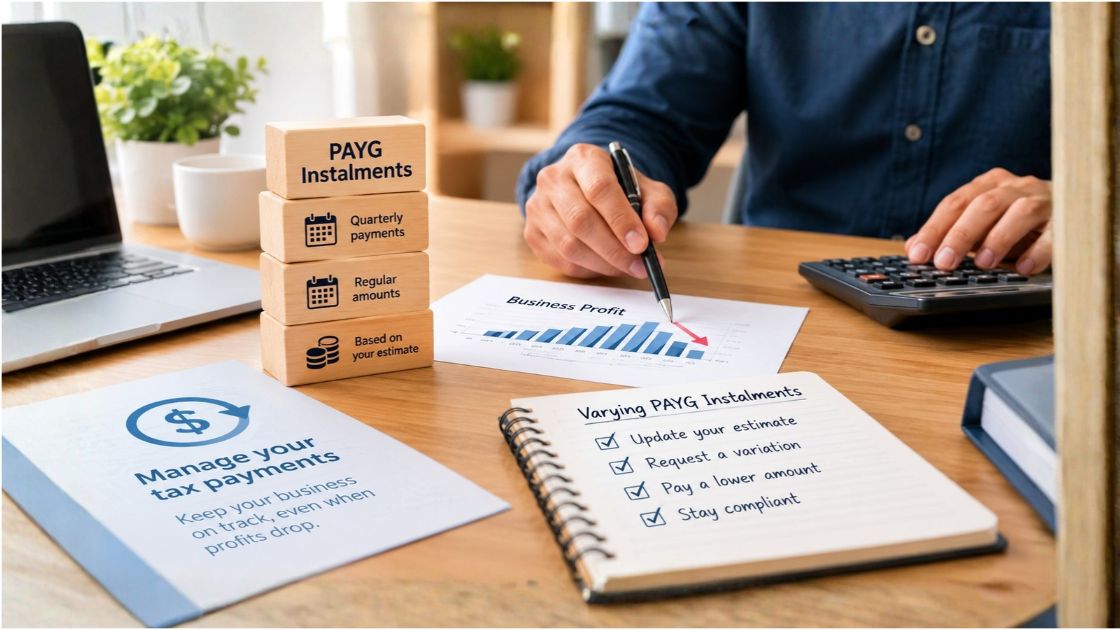
Pay As You Go (PAYG) instalments allow eligible Australian taxpayers to pay income tax progressively throughout the financial year instead of paying the entire amount after lodging their annual tax return.
They commonly apply to sole traders, business owners and investors who earn income outside regular salary and wage arrangements.
PAYG instalments are not an additional tax. They are payments towards your expected income tax liability, which is reconciled when your tax return is assessed.
For example, a Melbourne-based consultant may earn income through client projects rather than receiving a regular salary. If their income makes them eligible for PAYG instalments, the ATO may require them to make periodic payments based on their circumstances.
These payments help spread the tax burden across the year. However, if the consultant loses a major client or experiences a substantial drop in revenue, the original instalment calculation may no longer reflect their likely tax position.
That is when reviewing a PAYG instalment variation may be worthwhile.
How Are PAYG Instalments Calculated?
The ATO generally uses one of two methods to calculate PAYG instalments: an instalment amount or an instalment rate.
What Is the PAYG Instalment Amount Method?
Under the instalment amount method, the ATO provides an amount for the relevant instalment period. The amount is generally based on information from the taxpayer’s previous tax assessment, with applicable adjustments.
This approach can be straightforward when income remains relatively stable. However, the instalment may feel high if the business has experienced a significant downturn since the information used to calculate it was available.
Eligible taxpayers can consider varying the amount when their circumstances change, provided they follow the relevant ATO requirements.
What Is the PAYG Instalment Rate Method?
Under the instalment rate method, the taxpayer applies the relevant instalment rate to their instalment income for the reporting period.
For example, if a business has $40,000 in instalment income for a quarter and an applicable rate of 10%, the calculated instalment would be $4,000.
This is an illustrative calculation, not a rate recommendation. Your actual rate and instalment depend on your ATO information and circumstances.
The rate method can respond more directly to changes in income because the payment is linked to the relevant period’s instalment income. However, instalment income is not necessarily the same as accounting profit, so the method should not be confused with simply applying a percentage to net profit.
What Happens to PAYG Instalments When Business Profit Drops?
A decline in profit does not automatically reduce your PAYG instalments. If the current instalment no longer reflects your expected tax liability, you may need to review whether a variation is appropriate.
Several situations can trigger this review:
- A major customer reduces orders or cancels a contract.
- Sales fall during a seasonal downturn.
- Operating expenses increase and reduce profit margins.
- A construction or consulting project is delayed.
- Rental or investment income declines.
- The business changes its operations or reduces its workload.
Consider a Melbourne-based marketing agency that previously generated consistent monthly revenue but loses two significant clients. Its current-year revenue forecast is now substantially lower, and management expects a smaller taxable profit.
Continuing to pay instalments based on an earlier, stronger financial period could place unnecessary pressure on cash flow.
However, the agency should not reduce its payments based on one difficult month alone. It needs to consider year-to-date results, expected future sales, deductible expenses and other relevant income before estimating its likely tax liability.
A realistic forecast provides a stronger basis for deciding whether a variation is justified.
How Can You Vary PAYG Instalments With the ATO?
If you believe your current PAYG instalments are too high or too low, follow a structured process before making changes.
- Review your latest financial reports. Check sales, expenses, year-to-date profit, outstanding invoices and relevant investment income. Identify whether the decline is temporary or likely to continue.
- Forecast the rest of the financial year. Estimate future revenue, operating costs and deductible expenses. Consider seasonal patterns, confirmed contracts and any major changes in trading conditions.
- Estimate your likely tax position. Use the forecast to assess expected taxable income and the instalments already paid. Consider other income and relevant tax adjustments rather than looking at business revenue alone.
- Identify the correct variation method. Check whether your PAYG instalments use the amount method or rate method. The calculation and reporting requirements differ.
- Complete the relevant ATO form or activity statement. Follow the instructions applicable to your instalment method and report the variation correctly.
- Submit the variation by the relevant deadline. Check the due date for your specific instalment period and retain supporting calculations, reports and forecasts.
The ATO provides guidance on varying PAYG instalments, including how to calculate and report changes. Review the official instructions before lodging a variation, particularly if your circumstances are complex.
How Do You Calculate a Lower PAYG Instalment?
The appropriate calculation depends on your instalment method. The goal is to estimate a reasonable tax position based on current information, not simply to select the lowest possible payment.
For example, suppose a small Australian business initially expected a strong year but later lost a major contract. Its latest management accounts show lower revenue, while its updated forecast indicates that the decline is likely to continue.
The owner should review:
- Actual income and expenses to date.
- Expected sales for the remaining months.
- Anticipated operating costs and eligible deductions.
- Other relevant taxable income.
- PAYG instalments already paid.
- The method and calculation rules applicable to the account.
Under the amount method, the owner needs to follow the ATO’s procedure for varying the instalment amount. Under the rate method, the owner needs to determine an appropriate rate using the prescribed calculation process.
This is where reliable Accounting and Financial Reporting Services become valuable. Up-to-date profit and loss statements, cash flow forecasts and management reports help business owners support their estimates with evidence instead of guesswork.
What Are the Risks of Varying PAYG Instalments Too Low?
Reducing instalments may improve short-term cash flow, but an overly optimistic variation can create problems later.
If the amount paid during the year is insufficient, the taxpayer may face a larger balance when their annual tax return is assessed. General interest charges or penalties may also apply in relevant circumstances under the applicable rules.
Common mistakes include:
- Basing the variation on one poor trading month.
- Overestimating deductible expenses.
- Ignoring investment or other taxable income.
- Assuming a fall in revenue means an equivalent fall in tax.
- Failing to keep supporting calculations.
- Forgetting to review the forecast when business conditions improve.
For instance, a retailer might reduce instalments after a slow winter but then experience a strong sales period before the end of the financial year. If the forecast is not updated, the final tax position may be higher than expected.
A variation should be based on a reasonable estimate of the tax liability and the applicable ATO rules. If you are uncertain, seek professional tax advice before lodging it.
How Can Small Businesses Manage PAYG Instalments and Cash Flow Better?
PAYG instalments are easier to manage when tax planning is part of routine financial management rather than a last-minute task.
Australian small-business owners can improve their process by taking these steps:
- Update forecasts regularly: Compare actual results against your budget each month or quarter.
- Monitor profit, not just sales: Revenue can remain steady while rising costs reduce taxable profit.
- Keep tax funds separate: Avoid treating money reserved for tax as available working capital.
- Review major changes early: A lost contract, new expense or investment income change may justify reassessing the current instalment.
- Reconcile payments: Keep a record of instalments paid and check them against ATO statements.
- Maintain reliable financial reports: Accurate records make it easier to estimate income, monitor expenses and explain the basis for a variation.
Professional accounting support can help connect tax planning with cash flow management. For businesses across Melbourne and Australia, timely financial reporting can provide a clearer picture of performance and support better decisions when trading conditions change.
What Is the Difference Between PAYG Instalments and PAYG Withholding?
Although the names are similar, PAYG instalments and PAYG withholding serve different purposes.
|
PAYG instalments |
PAYG withholding |
|
Advance payments towards your own income tax liability |
Tax withheld from employees’ wages and certain other payments |
|
Commonly applies to eligible business and investment income |
Commonly applies to employers paying staff |
|
Paid by the taxpayer towards expected tax |
Withheld by the payer and remitted to the ATO |
A business owner may deal with both systems. For example, a company may have PAYG withholding obligations for its employees while an individual business owner separately pays PAYG instalments on relevant income.
Understanding the difference helps prevent confusion when reviewing tax obligations and cash flow.
Review Your Financial Reports Before Your Next PAYG Due Date
If your business profit has dropped, do not assume your existing PAYG instalments are still appropriate—or reduce them without checking the numbers. Review your latest financial results, prepare a realistic full-year forecast and confirm which variation method applies to your circumstances.
Accurate Accounting and Financial Reporting Services can help you understand changes in profitability, assess likely tax obligations and make better-informed cash flow decisions.
Before your next instalment deadline, speak with a qualified Australian accounting professional if you need help reviewing your figures or determining whether a variation is justified. Taking action early can help you manage working capital while reducing the risk of an unwelcome tax bill later.
Frequently Asked Questions About PAYG Instalments
Can I reduce PAYG instalments if my business makes less profit?
You may be able to vary your instalments if your expected tax liability has fallen. You must use the appropriate calculation method and follow the ATO’s rules. A reduction in profit does not automatically mean your instalment should fall by the same percentage.
Can I vary my PAYG instalments to zero?
A zero variation may be appropriate in certain circumstances, such as where the relevant estimated instalment income or tax liability is nil. You should assess your full circumstances and the applicable rules before reporting a zero amount or rate.
When should I vary my PAYG instalments?
Review your position when you have a reasonable basis to expect your current instalments no longer reflect your likely tax liability. Check the applicable reporting and payment deadlines before lodging a variation.
What happens if I pay too much PAYG instalment tax?
PAYG instalments are generally credited towards your final tax liability. Any excess is handled through the tax assessment process, subject to your overall tax position and any other amounts payable.
Can an accountant help me vary PAYG instalments?
Yes. An accountant can review financial reports, forecast income and expenses, estimate your tax position and help you follow the relevant variation process. This can be particularly useful when profits fluctuate or several income sources affect your tax liability.