





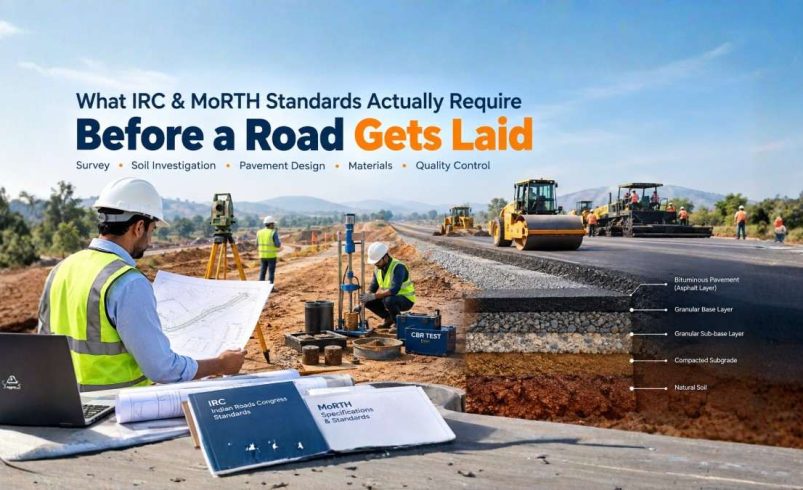
Summary — Road construction in India is not simply a matter of preparing the ground and laying asphalt. Before a road layer is accepted, engineers need to consider site conditions, pavement design, material sources, testing, compaction, drainage, quality control and project-specific specifications. IRC standards and MoRTH specifications provide important technical frameworks for these activities. Road Construction Material Testing Services help verify whether soil, aggregates, bituminous materials and other construction inputs meet the requirements specified for the project.
A newly laid road may look smooth and strong from the surface, but much of its performance depends on what happened underneath it.
Was the soil suitable? Were the aggregates tested? Was the subgrade properly compacted? Did the material meet the specified requirements? Were the pavement layers placed and tested correctly?
These questions are why road construction standards place such importance on investigation, material testing and quality control.
What Are IRC and MoRTH Standards for Road Construction?
The Indian Roads Congress (IRC) develops codes, standards, guidelines and special publications covering areas such as pavement design, highway engineering, traffic, road safety and construction practices.
MoRTH, the Ministry of Road Transport and Highways, issues specifications and project requirements for road and bridge works. Project documents can require compliance with applicable IRC codes, MoRTH specifications and other referenced standards.
For example, MoRTH project documentation requires quality systems to address sampling and testing of materials, test frequencies, acceptance criteria, testing facilities, reporting and documentation.
The exact requirements are not identical for every road. They depend on the project type, pavement system, contract documents, drawings and applicable standards.
What Must Be Checked Before Road Construction Starts?
Before construction begins, engineers need a clear understanding of the site and the proposed pavement structure.
This generally includes:
- Site and topographical surveys
- Alignment and existing-condition assessment
- geotechnical investigation Report
- Traffic assessment
- Pavement design
- Drainage planning
- Material source identification
- Construction methodology
- Quality assurance and testing arrangements
For highway projects, applicable manuals can require the concessionaire or contractor to undertake necessary surveys, investigations and detailed designs rather than simply relying on preliminary project information.
This matters because a pavement designed for one soil condition or traffic pattern may not be suitable for another.
Why Is Soil Testing Important Before Laying a Road?
The road pavement ultimately depends on its foundation.
If the subgrade has inadequate strength, excessive moisture, poor drainage or problematic soil characteristics, the pavement above it may experience settlement, deformation or premature distress.
Soil investigation can help engineers understand:
- Soil classification
- Moisture characteristics
- Strength and bearing behavior
- Compaction requirements
- Groundwater conditions
- Problematic or expansive soils
- Suitability of proposed construction materials
A practical example is a road constructed through an area containing weak or moisture-sensitive soil. Simply increasing the thickness of the asphalt layer may not solve the underlying problem. The subgrade itself may require treatment, replacement, stabilization or improved drainage.
This is where testing becomes part of engineering decision-making rather than merely paperwork.
What Road Construction Materials Need to Be Tested?
The exact testing program depends on the project specification and material being used.
Commonly evaluated materials include:
Soil and Embankment Material
Testing helps establish whether material is suitable for embankment or subgrade work and whether the required compaction can be achieved.
Aggregates
Aggregates used in pavement layers need to satisfy applicable requirements for properties such as grading, strength, durability and shape.
Granular Sub-Base and Base Materials
These materials form important structural layers below the bituminous surface. Their gradation, quality and field compaction can directly affect pavement performance.
Bituminous Materials
Bitumen and bituminous mixes require appropriate testing and quality control, including checks related to the specified material and mix characteristics.
Cement and Concrete
For rigid pavements and associated structures, cement, aggregates, concrete ingredients and finished concrete may require testing under the applicable specifications and standards.
MoRTH’s specification-revision documents also emphasize identifying material sources and testing samples from proposed sources for conformity with specifications.
What Role Do Road Construction Material Testing Services Play?
Road Construction Material Testing Services provide the testing support needed to determine whether construction materials Testing and completed pavement layers conform to specified requirements.
Depending on the project, services may involve:
- Soil testing
- Aggregate testing
- Subgrade evaluation
- Field density testing
- Compaction testing
- Bitumen testing
- Bituminous mix testing
- Concrete testing
- Material sampling
- Laboratory analysis
- Quality-control documentation
The important point is that testing should be linked to the project’s technical requirements.
A laboratory report is useful only when the sample, test method, specification, acceptance criterion and result are properly connected.
Why Is NABL Accreditation Important for Construction Material Testing?
How Important Is Compaction in Road Construction?
Compaction is one of the most practical quality-control activities in pavement construction.
A material may meet laboratory requirements but still perform poorly if it is not placed and compacted correctly in the field.
For example, inadequate compaction of a granular layer can create excessive voids or weak areas. Under repeated traffic loading, those areas may contribute to deformation or pavement distress.
Field density and moisture checks can therefore help confirm whether the constructed layer has achieved the specified requirements before the next layer is placed.
MoRTH quality-control guidance emphasizes recording test results and checking construction stages such as embankment, subgrade, sub-base, base course and wearing course before work proceeds further.
Why Does Drainage Matter Before a Road Is Laid?
Water is one of the most important factors engineers consider when assessing pavement performance.
A road needs an appropriate system for dealing with surface water, groundwater and runoff.
Depending on the project, this may involve:
- Side drains
- Cross drainage structures
- Culverts
- Camber or crossfall
- Shoulder drainage
- Subsurface drainage
- Protection against water infiltration
Consider a road in a high-rainfall area where water repeatedly accumulates along the pavement edge. Even a well-produced bituminous mix can experience problems if water is not effectively managed.
For roads in regions such as Maharashtra, drainage design deserves particular attention because seasonal heavy rainfall can expose weaknesses in pavement edges, shoulders and drainage arrangements.
What Happens Before the Bituminous Surface Is Laid?
Road construction generally progresses through controlled stages rather than putting the final surface directly onto the ground.
A simplified sequence may include:
Prepared ground → Embankment → Subgrade → Granular Sub-Base → Base Course → Prime/Tack Coat where specified → Bituminous Layer → Compaction and Finishing
Each layer has a purpose.
The subgrade provides the foundation. Granular layers distribute loads. Bituminous layers provide structural and functional pavement performance and a suitable riding surface.
The critical point is that each stage should satisfy the applicable project requirements before the next stage proceeds.
How Does Quality Control Work on a Road Project?
Quality control is not one test performed at the end of construction.
It is a continuous process involving sampling, testing, inspection, documentation and corrective action.
A project Quality Assurance Plan may define:
- What materials will be tested
- Where samples will be collected
- Which test methods will be used
- How frequently tests will be performed
- Acceptance criteria
- Testing responsibilities
- Documentation procedures
- Calibration requirements
- Corrective actions
MoRTH’s EPC framework, for example, requires a Quality Assurance Plan covering sampling and testing, test frequencies, standards, acceptance criteria, facilities, reporting and interpretation of results.
Recent MoRTH amendments also place emphasis on witnessing quality-control tests and reviewing quality-control documentation for applicable works.
Does Every Road Follow the Same IRC and MoRTH Requirements?
No.
This is an important distinction.
A national highway, urban road, rural road, expressway, rehabilitation project and road-widening project may have different technical requirements.
Requirements can also change depending on:
- Flexible or rigid pavement
- New construction or rehabilitation
- Traffic volume
- Soil conditions
- Climate
- Project contract
- Design requirements
- Applicable IRC provisions
- Applicable MoRTH specifications
- Referenced Indian Standards
Some highway manuals explicitly state that the applicable standards include IRC codes, MoRTH specifications and other standards referenced in the project documents.
Therefore, a generic internet checklist should never replace the actual contract documents and applicable technical specifications.
What Happens When Materials Fail the Required Tests?
A failed test result does not automatically mean the entire road is unusable.
The response depends on the material, test, location, specification and severity of the non-conformance.
Possible actions can include:
- Additional sampling
- Retesting where permitted
- Investigation of the affected area
- Material rejection
- Removal and replacement
- Corrective processing
- Additional compaction
- Engineering review
The objective is to identify non-conforming work before it becomes part of a completed pavement system.
That is why testing records should be maintained throughout construction rather than reconstructed after the project is finished.
Why Should Material Testing Be Done at Every Major Construction Stage?
Imagine a contractor discovers that the finished road has premature rutting.
If material testing construction records were maintained throughout the project, engineers can investigate possible causes by reviewing:
- Aggregate test results
- Mix characteristics
- Layer thickness
- Compaction records
- Field density
- Temperature records
- Source approvals
- Inspection reports
Without reliable records, identifying the root cause becomes much harder.
Good testing therefore provides more than a pass-or-fail result. It creates a technical record of how the road was constructed.
What Should Engineers Check Before Approving the Next Road Layer?
A practical quality-control checklist should include:
- Has the previous layer been inspected?
- Are material test results available?
- Does the material meet the specified requirements?
- Has required compaction been achieved?
- Are thickness and levels within specified tolerances?
- Is drainage functioning as designed?
- Are test instruments properly calibrated?
- Are inspection records complete?
- Has the relevant engineer approved progression to the next stage?
MoRTH guidance has specifically emphasized stage-wise inspection and certification before construction proceeds from one major road layer to the next.
What Should You Check Before Road Construction Begins?
A road should not be judged only by how smooth it looks after completion.
Before construction begins, project teams should confirm the applicable IRC provisions, MoRTH specifications, drawings, material sources, testing requirements, quality assurance plan, drainage arrangements and inspection procedures.
For contractors, developers, infrastructure companies and project authorities, arranging appropriate Road Construction Material Testing Services in Pune early can help identify unsuitable materials and construction issues before they become expensive rework.
If you are planning a road, pavement, highway, widening or rehabilitation project, consult a qualified road-testing laboratory or highway engineering professional before construction begins. Share the project specifications, material sources and testing requirements with the testing team so that the testing program can be aligned with the actual technical and acceptance criteria of the project.
Frequently Asked Questions About Road Construction Material Testing Services
What are Road Construction Material Testing Services?
Road Construction Material Testing Services involve laboratory and field testing of materials such as soil, aggregates, bitumen, concrete and pavement layers to determine whether they meet the requirements specified for a road project.
What materials are tested before road construction?
Commonly tested materials include soil, embankment material, aggregates, granular materials, bitumen, bituminous mixes, cement and concrete. The exact testing schedule depends on the project specifications and applicable standards.
Why is soil testing important for road construction?
Soil testing helps engineers understand subgrade strength, moisture behavior, compaction characteristics and other properties that influence pavement design and long-term performance.
Are IRC standards and MoRTH specifications mandatory for every road?
Not necessarily in exactly the same way. Their applicability depends on the project, contract documents, applicable technical specifications and the type of road work. The governing project documents should always be checked.
When should road material testing be performed?
Testing can occur before construction to approve materials and sources, during construction to control pavement layers and materials, and after construction to verify specified properties of completed work. The required timing and frequency depend on the applicable specification.