




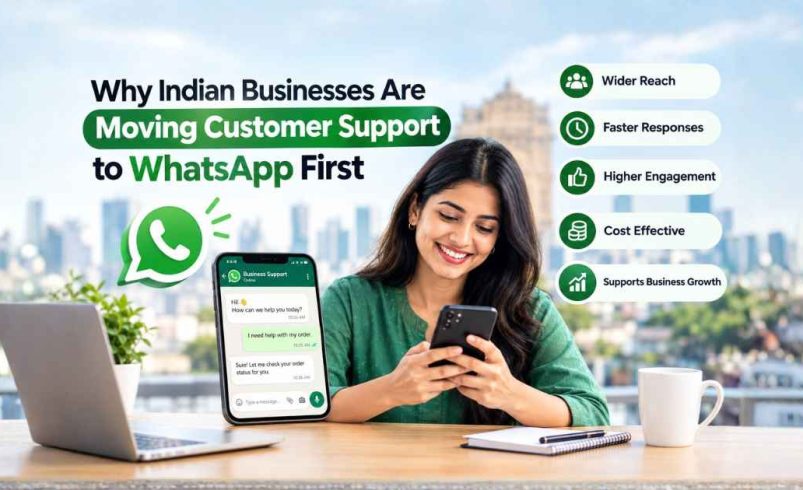
Summary – Indian businesses are moving customer support to WhatsApp because customers already use it for everyday communication and expect quick, convenient responses. WhatsApp enables businesses to combine real-time conversations, automation, chatbots, rich media, CRM integration, and human support in one familiar channel. For Indian companies, this makes customer service faster, more accessible, and easier to scale.
Think about the last time you needed an update from a business. Would you rather wait on a phone call, search through an email thread, or simply send a WhatsApp message?
For millions of Indian customers, WhatsApp is already the easiest answer.
Businesses have noticed this behaviour. Instead of asking customers to move to another platform for support, many companies are bringing customer service directly into the messaging channel customers already understand.
This shift is often described as WhatsApp-first customer support. It does not mean businesses are completely abandoning phone, email, websites, or other channels. It means WhatsApp becomes the first and most convenient support touchpoint for common customer questions.
From ecommerce and education to healthcare, banking, retail, and travel, the use cases are expanding quickly.
What Does WhatsApp-First Customer Support Actually Mean?
WhatsApp-first customer support means using WhatsApp as a primary channel for customer conversations, service requests, updates, and problem resolution.
A customer might ask:
- “Where is my order?”
- “Can I reschedule my appointment?”
- “What documents do I need?”
- “Can you send me the product catalogue?”
- “Why has my payment failed?”
- “How can I speak to an agent?”
Instead of forcing that customer to call a helpline or submit a website form, the business can respond within the same conversation.
With the right setup, the interaction can move from an automated response to an AI chatbot, CRM lookup, and finally a human support agent when required.
That is where WhatsApp becomes more than a messaging application. It becomes a customer-support workflow.
Why Are Indian Customers Comfortable With WhatsApp Support?
The biggest advantage is familiarity.
Customers do not need to learn a new application or complicated support portal. They already know how to send a message, share a document, upload a photo, or respond to a conversation.
This matters particularly in India’s mobile-first market.
A customer in Mumbai may use WhatsApp to ask about an order, while a customer in Pune may send a screenshot of a payment problem. A customer in Jaipur may prefer Hindi, while another customer in Bengaluru may communicate in English.
Businesses can design support experiences around these real-world communication habits.
Another advantage is convenience. A phone call requires the customer to stay available during the conversation. WhatsApp allows customers to send a message and continue with their day.
WhatsApp vs Email and Phone Support: Which Is Better?
There is no single channel that is best for every situation.
Phone support remains valuable for complicated or urgent issues. Email is useful for formal communication and detailed documentation. But WhatsApp offers a strong middle ground: direct, conversational, fast, and capable of automation.
For example, an ecommerce company could use WhatsApp to provide an order-status update. If the customer has a problem with the delivery, the conversation can be transferred to a support agent.
That creates a smoother experience than sending the customer from WhatsApp to a separate support portal.
The strongest strategy is therefore not WhatsApp instead of everything else. It is WhatsApp as the first support layer, connected to the rest of the customer-service system.
What Can Businesses Handle Through WhatsApp Customer Support?
A surprising number of repetitive support tasks can be handled through WhatsApp.
Businesses can automate:
- Frequently asked questions
- Order tracking
- Appointment confirmations
- Booking information
- Product enquiries
- Payment reminders
- Delivery notifications
- Document sharing
- Customer feedback
- Support-ticket creation
- Lead qualification
- Basic troubleshooting
Consider a healthcare provider. Instead of asking patients to call reception simply to confirm an appointment, the business can send a WhatsApp reminder and allow the customer to respond directly.
Similarly, an education company can answer common admission questions automatically before connecting serious applicants with an admissions counsellor.
How AI Chatbots Are Changing WhatsApp Customer Service
Automation becomes significantly more useful when businesses combine WhatsApp with AI. Businesses can use the WhatsApp Business Platform with WhatsApp AI chatbots to understand customer queries, automate responses, and hand complex conversations to human agents.
A traditional chatbot may respond to predefined commands. An AI chatbot can understand natural-language questions and identify customer intent more effectively.
For example, a customer might write:
“I ordered this three days ago and haven’t received it yet. Can you check?”
The system can identify that the customer needs an order-status update, retrieve relevant information from the CRM or order-management system, and provide an appropriate response.
If the problem requires human intervention, the conversation can be handed to an agent.
This AI + WhatsApp + CRM model can reduce repetitive workload while allowing support teams to spend more time on complex customer issues.
Multilingual support is another important opportunity for Indian businesses, particularly those serving customers across different states and regions.
Why CRM Integration Matters for WhatsApp Support
A WhatsApp conversation becomes much more valuable when it is connected to customer data.
Without integration, an agent may have to ask:
“Please provide your order number.”
With CRM integration, the system may already know the customer’s previous interactions, enquiry history, purchase details, or support tickets.
That context can make conversations faster and more personal.
For growing companies, this also helps create a centralised support process instead of leaving customer conversations scattered across individual phones.
Choosing the Right WhatsApp Business API Provider in India
For businesses handling significant customer communication, choosing a reliable WhatsApp Business API provider in India is an important step.
The right provider should support more than message delivery. Businesses should evaluate capabilities such as:
- Official WhatsApp Business Platform/API access
- CRM and software integrations
- Chatbot and automation support
- Multiple-agent customer service
- Message templates and notifications
- Delivery and conversation analytics
- Scalability for growing message volumes
- Reliable technical support
- Security and compliance practices
The choice should depend on the company’s actual workflow.
A small retailer may primarily need automated FAQs and customer conversations, while an enterprise may require CRM integration, multiple support agents, AI automation, analytics, and large-scale notifications.
Which Indian Industries Can Benefit Most From WhatsApp-First Support?
Ecommerce and D2C
Customers frequently ask about orders, deliveries, returns, refunds, and product availability.
WhatsApp can bring these interactions into one conversational channel.
Banking and Fintech
Financial businesses can use messaging for service information, transaction-related notifications, reminders, and customer assistance, subject to applicable security and regulatory requirements.
Healthcare
Appointment reminders, booking assistance, basic enquiries, and follow-up communication are practical WhatsApp use cases.
Education
Coaching institutes, colleges, edtech companies, and training providers can use WhatsApp for education to handle course enquiries, admissions questions, application updates, and student communication.
Retail
Retailers can share product information, catalogues, offers, store information, and after-sales support through conversational messaging.
Travel and Hospitality
Hotels, travel agencies, and other businesses can use WhatsApp for booking assistance, confirmations, itinerary communication, and customer queries.
How Should a Business Build a WhatsApp-First Support Strategy?
Simply adding a WhatsApp number to a website is not enough.
A practical implementation can follow five steps.
First, identify repetitive questions.
Find the queries support teams answer every day.
Second, automate simple interactions.
Create FAQs, greetings, order-status workflows, and basic self-service options.
Third, connect WhatsApp with CRM and business systems.
Give the support system access to the information needed to answer customer questions.
Fourth, establish human handover.
Customers should be able to reach a human when automation cannot solve the issue.
Finally, measure performance.
Track response time, resolution time, customer satisfaction, automation rate, escalation rate, and support volume.
This approach prevents WhatsApp from becoming another disconnected inbox.
What Mistakes Should Businesses Avoid?
One common mistake is treating WhatsApp support like a personal messaging account.
Another is automating everything.
Customers do not want to repeatedly type commands into a rigid bot when they have a complicated problem.
Businesses should also avoid slow responses, confusing chatbot menus, irrelevant promotional messages, and conversations that provide no clear path to a human agent.
The objective is not simply to automate communication. It is to make customer support easier for the customer.
What Does the Future of WhatsApp Customer Support Look Like?
The next stage is likely to be more conversational and intelligent.
Instead of customers navigating multiple menus, they will increasingly explain what they need in ordinary language. AI can understand the request, access relevant business information, complete simple tasks, and involve a human when necessary.
For Indian businesses, this could be particularly valuable because customer support often needs to work across different languages, regions, devices, and customer expectations.
WhatsApp can therefore become the front door to a broader customer-service ecosystem involving AI chatbots, CRM systems, automated notifications, human agents, and other communication channels.
Start Building a Better WhatsApp Customer Support Experience
Customers are not necessarily asking businesses to communicate through more channels. They are asking for simpler conversations and faster answers.
That is why WhatsApp-first support is gaining traction in India.
Businesses that combine the familiarity of WhatsApp with automation, AI, CRM integration, and human assistance can create a support experience that is easier to access and easier to scale.
If your customers are already asking questions on WhatsApp, the next step is to turn those conversations into a structured customer-support system. Evaluate your current support queries, identify what can be automated, and choose a WhatsApp Business API solution that can grow with your customer base.
Frequently Asked Questions
Why are Indian businesses choosing WhatsApp for customer support?
Indian businesses are choosing WhatsApp because customers already use it regularly and expect quick, convenient communication. It also supports automation, chatbots, rich media, CRM integration, and human agent support in one channel.
What is WhatsApp-first customer support?
WhatsApp-first customer support means making WhatsApp the primary channel for customer enquiries, updates, and support. Businesses can use it for FAQs, order tracking, appointment support, notifications, and direct conversations with support agents.
Can WhatsApp customer support be automated?
Yes. Businesses can automate common questions, order updates, appointment reminders, and other repetitive tasks using the WhatsApp Business Platform, chatbots, and CRM integrations. Complex queries can still be transferred to a human agent.
Is WhatsApp better than phone or email for customer support?
WhatsApp can be more convenient for many everyday support queries because customers can send messages, documents, images, and other information without waiting on a call. However, phone and email remain useful for complex, formal, or sensitive support requirements.
How can businesses improve customer support with WhatsApp and AI?
Businesses can combine WhatsApp with AI chatbots and CRM systems to understand customer questions, provide instant answers, automate repetitive tasks, and route complex issues to human agents. This creates faster and more personalised customer support.