




Summary – AI voice bots are helping businesses reduce call center costs by automating repetitive customer conversations, improving response times, and providing 24/7 support without increasing staffing expenses. By handling routine inquiries, reducing call volumes for human agents, and improving operational efficiency, AI voice bots enable organizations to deliver better customer experiences while lowering long-term support costs.
Every business wants to provide excellent customer service, but doing that at scale isn’t easy. As customer expectations continue to grow, so do the costs of running a call center. Hiring more agents, training new employees, managing peak-hour call volumes, and offering round-the-clock support all require significant investment.
At the same time, customers have become less patient. They expect quick answers, shorter waiting times, and support that’s available whenever they need it. If those expectations aren’t met, many simply move on to a competitor.
This is exactly why AI voice bots have become one of the fastest-growing technologies in customer service.
Instead of replacing human agents, voice bots take care of repetitive conversations that don’t require manual intervention. Whether someone wants to check an order status, confirm an appointment, pay a bill, or get basic account information, an AI voice bot can handle these requests within seconds.
The result is simple: businesses reduce operating costs, employees spend more time on meaningful conversations, and customers receive faster support.
What Is an AI Voice Bot?
An AI voice bot is an intelligent virtual assistant that communicates with customers over phone calls using artificial intelligence. Unlike traditional IVR systems that ask callers to press different numbers, AI voice bots understand natural speech and respond conversationally.
For example, instead of hearing:
“Press 1 for billing or Press 2 for technical support.”
A customer can simply say:
“I want to know where my order is.”
The voice bot understands the request, checks the connected system, and provides an instant update.
Behind the scenes, technologies such as speech recognition, Natural Language Processing (NLP), machine learning, and text-to-speech work together to understand customer intent and generate accurate responses.
Because the interaction feels natural, customers can solve their problems much faster than with traditional automated phone menus.
Why Are Call Center Costs Rising?
Running a customer support team has become increasingly expensive for businesses of every size.
The most obvious expense is staffing. Recruiting skilled agents, providing ongoing training, managing shifts, and retaining experienced employees all add to operational costs. Since the call center industry often experiences high employee turnover, businesses also spend considerable time and money replacing staff.
Another challenge is fluctuating call volumes.
Retail businesses receive thousands of additional calls during festive sales. Hospitals experience appointment inquiries during seasonal health campaigns. Banks handle more customer requests around salary days, loan repayments, and financial year-end activities.
To prepare for these busy periods, companies usually hire temporary staff or ask existing employees to work overtime, both of which increase costs.
Customers also expect support outside normal business hours. Maintaining a 24/7 customer service team requires multiple shifts, additional supervisors, and higher infrastructure costs.
This is where AI voice bots make a real difference.
How Voice Bots Help Reduce Call Center Costs
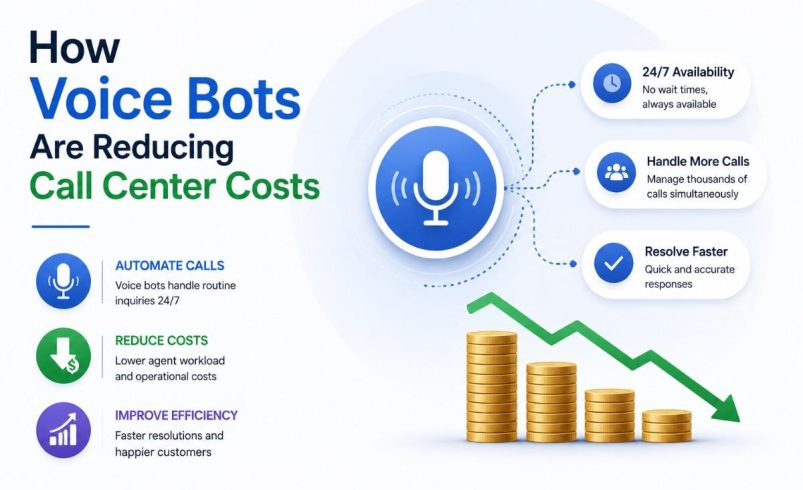
One of the biggest advantages of AI voice bots is that they can handle thousands of repetitive customer conversations without increasing operational expenses.
Think about the types of calls businesses receive every day.
Customers ask about delivery updates, appointment confirmations, payment reminders, account balances, business hours, password resets, and booking status. While these requests are important, they don’t always require a live agent.
By automating these routine interactions, businesses immediately reduce the number of calls reaching customer support teams.
For example, an online retailer receiving 10,000 customer calls each week may find that more than half of those calls are simply asking where an order is. Instead of assigning dozens of agents to answer the same question repeatedly, an AI voice bot can provide delivery updates automatically.
This allows customer support representatives to focus on issues that genuinely require human judgment, such as handling complaints, resolving technical problems, or assisting customers with complex requests.
The result is higher productivity without increasing team size.
Another major advantage is availability.
Unlike human agents, AI voice bots don’t require breaks, holidays, or shift changes. They provide consistent customer support 24 hours a day, seven days a week.
This is especially valuable for businesses serving customers across different time zones or industries where support requests arrive throughout the day.
Voice bots also reduce Average Handling Time (AHT), one of the most important metrics in customer service.
Instead of searching through multiple systems, placing customers on hold, or transferring calls between departments, AI voice bots retrieve information instantly and provide immediate responses.
Even saving one or two minutes per call can result in significant annual savings for organizations handling thousands of customer interactions every month.
Another area where businesses save money is call scalability.
Traditional call centers have limited capacity because every customer requires an available agent.
AI voice bots don’t have this limitation.
Whether there are 100 incoming calls or 10,000, the system can manage multiple conversations simultaneously without increasing staffing costs or making customers wait in long queues.
How Outbound Voice Calls Services Complement AI Voice Bots?
AI voice bots efficiently handle incoming customer inquiries, while Outbound Voice Calls services help businesses proactively connect with customers through appointment reminders, payment alerts, delivery updates, renewal notifications, and feedback requests. By sharing important information before customers need to call, businesses can significantly reduce inbound call volumes.
For example, a hospital can send automated appointment reminders, while a logistics company can provide delivery updates through outbound voice calls. When combined with AI Voice Bot Services, businesses create a complete voice automation solution that improves customer communication, reduces call center workloads, and lowers operational costs.
Human Agents vs. AI Voice Bots
|
Feature |
Human Agents |
AI Voice Bots |
|
Availability |
Limited working hours |
24/7 support |
|
Calls Handled |
One at a time |
Thousands simultaneously |
|
Response Time |
Depends on queue |
Instant |
|
Training Cost |
Ongoing |
Minimal updates |
|
Scalability |
Requires hiring |
Instantly scalable |
|
Consistency |
May vary |
Consistent responses |
Rather than replacing employees, AI voice bots complement human teams by handling repetitive work and allowing agents to focus on conversations where empathy, decision-making, and expertise matter most.
Industries Already Saving Money with AI Voice Bots
AI voice bots are no longer limited to large enterprises. Businesses of all sizes are using them to improve customer service while keeping operational costs under control.
Banking and Financial Services: Banks receive thousands of routine calls about account balances, loan status, EMI reminders, card activation, and transaction updates. AI voice bots can answer these requests instantly, allowing customer support teams to focus on more complex financial queries.
Healthcare: Hospitals and clinics use voice bots to schedule appointments, send reminder calls, share diagnostic updates, and answer common patient questions. This reduces the workload on front-desk staff and improves the patient experience.
E-commerce and Retail: During festive sales or promotional campaigns, online retailers often see a surge in customer inquiries about order tracking, returns, refunds, and delivery updates. AI voice bots handle these conversations efficiently, helping businesses manage high call volumes without hiring additional agents.
Logistics and Courier Services: Customers frequently call to check shipment status or reschedule deliveries. Automating these requests improves response times and reduces pressure on customer support teams.
Education: Schools, colleges, and universities receive thousands of admission-related inquiries during enrollment periods. Voice bots can answer questions about courses, eligibility, fees, and application status, making the admission process smoother for both students and institutions.
A Real-World Example
Imagine an online retailer preparing for a major festive sale. Orders increase rapidly, and so do customer calls. Most callers simply want to know when their package will arrive.
Instead of assigning additional support agents, the company deploys an AI voice bot connected to its order management system. Customers receive real-time delivery updates through a natural conversation without waiting in a queue.
As a result, support agents can dedicate their time to handling payment issues, damaged products, or return requests. Customers get faster answers, employees experience less pressure, and the business avoids the cost of expanding its call center during peak seasons.
This example shows why many organizations now see AI voice bots as a practical business investment rather than just another technology trend.
AI Voice Bots vs. Traditional IVR
Many businesses still rely on Interactive Voice Response (IVR) systems, but customer expectations have changed. People no longer enjoy navigating multiple menu options before reaching the right department.
Here’s how the two compare:
|
Feature |
Traditional IVR |
AI Voice Bot |
|
Interaction Style |
Menu-based |
Conversational |
|
Understands Natural Language |
No |
Yes |
|
Customer Experience |
Basic |
Personalized |
|
Learns Over Time |
No |
Yes |
|
Call Routing |
Rule-based |
Intelligent |
|
Scalability |
Limited |
Highly scalable |
For businesses focused on improving both efficiency and customer satisfaction, AI voice bots offer a far more flexible solution than traditional IVR systems.
Best Practices for Implementing AI Voice Bots
Introducing AI voice automation doesn’t have to be complicated. Businesses that see the best results usually begin with routine customer interactions before expanding automation across other processes.
A few best practices include:
- Start by automating high-volume, repetitive inquiries.
- Integrate the voice bot with your CRM or customer database.
- Keep a smooth handoff to human agents for complex conversations.
- Regularly review customer interactions to improve AI accuracy.
- Monitor key metrics such as response time, call resolution, and customer satisfaction.
- Support multiple languages if your customers come from different regions.
Following these steps helps businesses improve efficiency while maintaining a positive customer experience.
The Future of AI Voice Bots
Voice AI is advancing quickly, and businesses are already seeing the benefits of more intelligent and personalized customer interactions.
Future AI voice bots are expected to understand customer intent even more accurately, recognize emotions during conversations, and provide highly personalized responses using real-time customer data. Combined with technologies like AI Chatbot Software, businesses will be able to deliver seamless support across voice, chat, WhatsApp, RCS, and other communication channels.
As customer expectations continue to evolve, companies that embrace AI-powered communication today will be better prepared to deliver faster, more efficient service in the years ahead.
Ready to Make Customer Support Smarter?
Reducing call center costs isn’t about replacing people—it’s about helping your team work more efficiently. AI voice bots automate repetitive conversations, improve response times, and allow customer service professionals to focus on interactions that create real value.
Businesses looking to build a modern communication strategy often combine AI Voice Bot Services with complementary solutions such as Outbound Voice Calls services, Bulk Voice Calling Service, Promotional Voice Calls Service, Transactional Voice Calls Reseller, WhatsApp API Provider, RCS Service Provider, OTP SMS Service, Voice OTP Delivery Services, Transactional SMS Service, SMS Notification Service, SMPP Server Service, Bulk SMS Reseller Services, Missed Call Services, Toll-free number provider, and DLT Registration. Working with an experienced provider like WebXion can help you integrate these solutions into a scalable customer engagement strategy that improves efficiency, enhances customer experiences, and supports long-term business growth.
Frequently Asked Questions
How do AI voice bots reduce call center costs?
AI voice bots automate repetitive customer conversations, reduce call handling time, minimize staffing requirements, and provide 24/7 support, helping businesses lower operational expenses.
Can AI voice bots replace human agents?
No. They are designed to handle routine inquiries while allowing human agents to focus on complex issues that require empathy, critical thinking, or personalized assistance.
Which industries benefit the most from AI voice bots?
Banking, healthcare, retail, e-commerce, logistics, education, insurance, telecommunications, and travel businesses all benefit from AI-powered voice automation.
Are AI voice bots suitable for small businesses?
Yes. Cloud-based AI voice solutions make automation affordable for startups and small businesses, helping them provide professional customer support without building large call center teams.
Can AI voice bots work with existing business software?
Most modern voice bots integrate with CRM platforms, helpdesk systems, ERP software, and order management tools, allowing them to provide personalized and real-time responses
How do businesses choose the right AI voice bot provider?
Look for a provider that offers natural language capabilities, multilingual support, secure integrations, detailed analytics, scalability, and reliable technical support.