


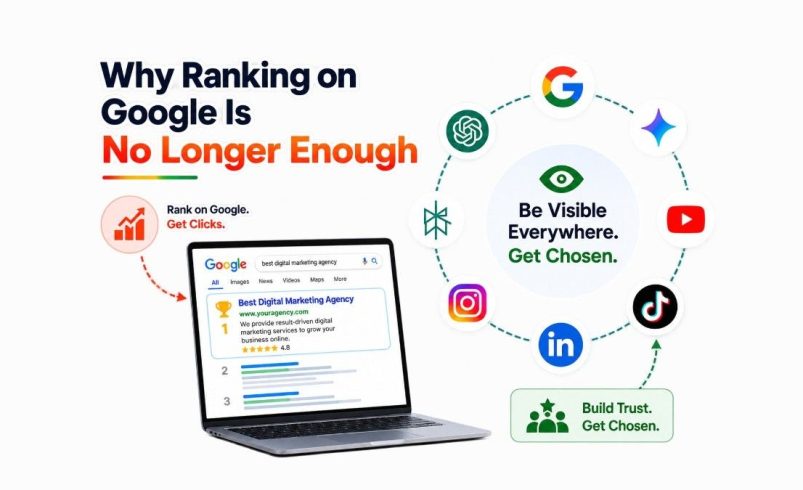
Summary – Ranking on Google is still important, but it is no longer enough to guarantee visibility, traffic, or business growth. Search behaviour has expanded beyond traditional blue links to Google AI Overviews, featured snippets, YouTube, social platforms, Reddit, ChatGPT, Gemini, and other AI-powered answer engines. Businesses now need a broader search visibility strategy that combines SEO, AEO, GEO SEO, LLM SEO, brand authority, content, digital PR, and conversion optimization. The goal is no longer simply to rank #1—it is to become a trusted answer wherever potential customers search.
Is Ranking #1 on Google Still Enough?
For years, ranking on the first page of Google was considered the ultimate SEO goal. A business could target valuable keywords, reach position one, generate organic clicks, and turn that traffic into leads or sales.
That model still matters, but search has changed.
A website can rank in the top three positions and still receive fewer clicks than expected because users may find their answer through an AI Overview, featured snippet, local pack, video, or another SERP feature without visiting the website.
For example, someone searching “best digital marketing agency in Pune” may see local businesses, reviews, map results, service pages, social profiles, and AI-generated information before clicking a traditional organic result.
This means businesses need to ask a bigger question:
“How visible is my brand across the entire search journey?”
That is the foundation of modern SEO.
Why Are Google Rankings No Longer the Only Measure of SEO Success?
1. Zero-Click Searches Are Changing User Behaviour
A zero-click search happens when users get the information they need directly from the search results without clicking a website.
Featured snippets, People Also Ask, knowledge panels, local results and other search features can answer questions immediately.
Suppose someone searches:
“How much does SEO cost for a small business?”
They might see a direct answer, related questions and local results before deciding whether they need to visit a website.
So instead of measuring success only through clicks, businesses should also monitor impressions, SERP visibility, featured results, brand searches, leads and conversions.
2. Google AI Overviews Are Creating a New Search Experience
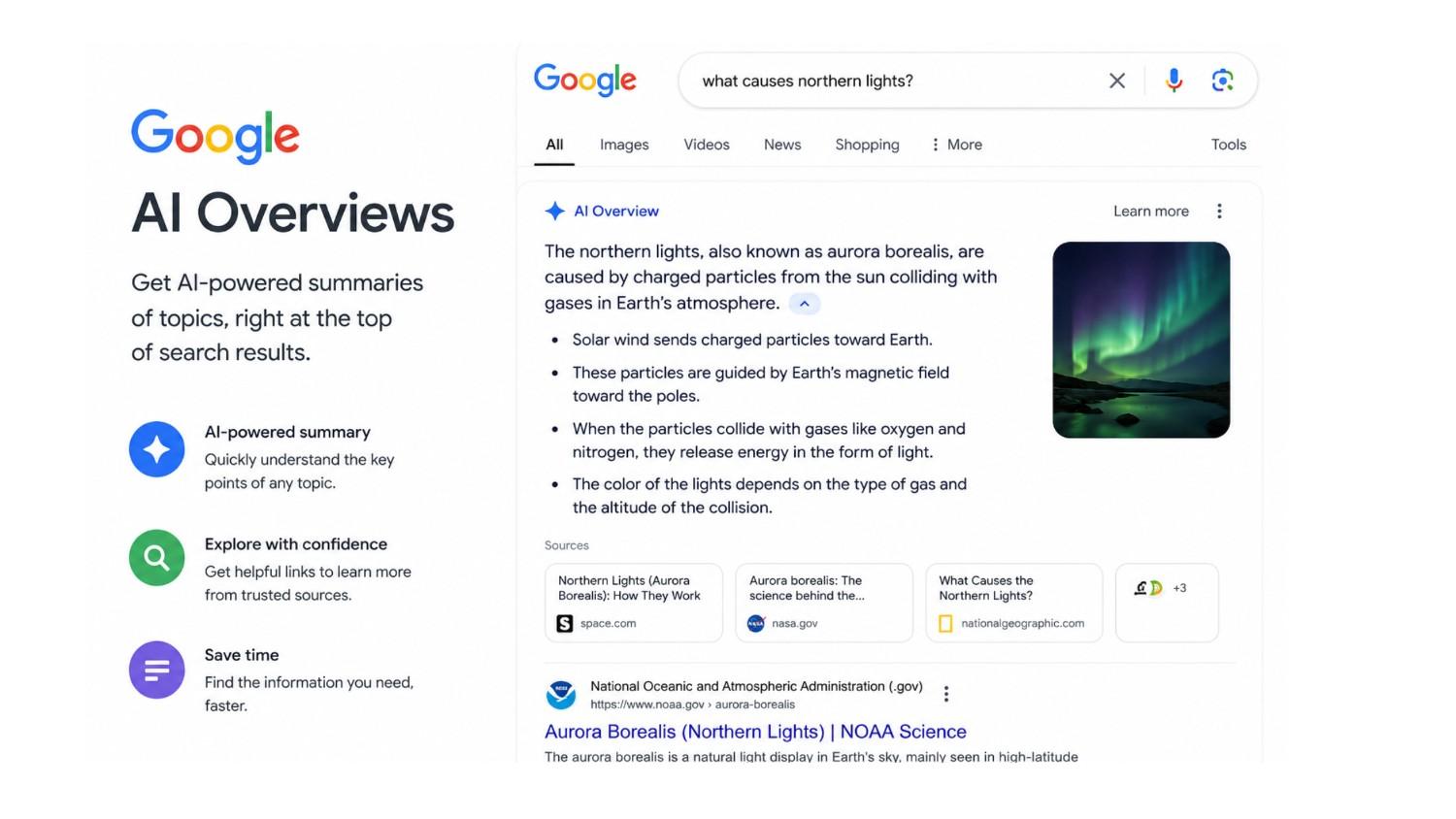
AI-generated answers are changing how users consume search information. Instead of scanning multiple websites, users can receive a summarized response and then choose which sources or businesses to explore further.
This creates a new opportunity.
A company doesn’t only want its webpage to rank. It wants its expertise, content, brand and supporting information to become strong enough to be recognized as a useful source.
That requires clear explanations, original information, trustworthy sources, structured content and strong topical authority.
Are People Still Searching Only on Google?
No. Search behaviour now happens across multiple platforms.
Depending on the query, users may search through:
- YouTube
- Amazon
- Quora
- TikTok
- ChatGPT
- Google Gemini
- Perplexity
For instance, someone researching a software product may use Google for comparisons, YouTube for demonstrations, Reddit for genuine user experiences and ChatGPT for a simplified explanation.
A business that focuses exclusively on Google rankings can therefore miss several important discovery points.
Modern SEO is increasingly about being discoverable wherever your audience looks for information.
What Is the Difference Between Ranking and Search Visibility?
Ranking refers to where a webpage appears for a particular search query.
Search visibility is broader. It includes how frequently and prominently your brand appears across search results, AI answers, local listings, videos, social platforms, media coverage and other digital touchpoints.
Consider a local business in Pune.
It may rank for “SEO agency in Pune,” but potential customers could also discover it through.
- Google Business Profile
- LinkedIn posts
- YouTube videos
- Industry articles
- Client reviews
- Digital PR coverage
- AI-generated recommendations
- Branded searches
That wider presence can create more trust than a single keyword ranking.
How Are AEO, GEO SEO and LLM SEO Changing Search?
What Is Answer Engine Optimization (AEO)?
AEO is the practice of structuring content so search engines and answer engines can easily understand and extract direct answers.
AEO focuses heavily on questions users actually ask.
Instead of writing only:
“SEO Services”
a business might create useful sections such as:
- What does SEO do for a business?
- How long does SEO take?
- How much does SEO cost?
- What is local SEO?
- How can SEO generate leads?
Direct answers, clear headings, concise explanations and FAQ content can improve the chances of being surfaced for informational searches.
What Is GEO SEO?
Generative Engine Optimization (GEO) focuses on improving a brand’s visibility in AI-generated search experiences.
GEO involves creating authoritative, context-rich content that clearly establishes:
- What the business does
- Who it serves
- Where it operates
- What expertise it has
- Which services it provides
- Why it is credible
For a Pune-based company, this could mean developing genuinely useful content around digital marketing challenges faced by businesses in Pune, PCMC, Mumbai and other relevant service areas.
What Is LLM SEO?
LLM SEO focuses on helping large language models understand a brand, its expertise, services and relationships with relevant topics.
Consistent business information, authoritative content, expert contributions, reviews, mentions and credible references can all contribute to stronger digital entity recognition.
The objective isn’t to “write for AI” instead of humans. It is to make information clear enough for humans and machines to understand accurately.
Why Is Topical Authority More Important Than Publishing More Content?
Publishing dozens of generic articles does not automatically establish expertise.
A stronger approach is to build a topic systematically.
For example, a digital marketing agency could create a central SEO guide supported by articles about:
- Local SEO
- Technical SEO
- Keyword research
- Google Business Profile
- SEO for small businesses
- GEO
- AEO SEO
- AI search
- Content marketing
- Conversion optimization
This creates a connected knowledge base rather than isolated blog posts.
Practical insight: Before publishing another article, ask whether it strengthens an existing topic cluster or simply repeats information already available online.
Why Brand Authority Matters More Than Ever?
Search engines and AI systems need context to understand which information deserves attention.
That’s why brand authority matters.
Businesses can strengthen authority through:
- Original research
- Case studies
- Expert commentary
- Customer reviews
- Digital PR
- Industry publications
- Useful educational content
- Consistent company information
- Genuine social engagement
For example, a local service provider targeting customers in Pune and Pimpri-Chinchwad can build stronger relevance by publishing practical content based on local customer questions rather than producing generic city pages stuffed with keywords.
Local relevance should demonstrate actual knowledge—not simply repeat the city name.
How Should Businesses Measure SEO Success in 2026?
Keyword rankings should remain part of the reporting process, but they shouldn’t be the entire report.
Track:
- Organic impressions
- Qualified organic traffic
- Search visibility
- Leads generated
- Conversion rate
- Revenue from organic search
- Brand searches
- Featured snippets
- AI visibility
- Local search performance
- Engagement
- Returning visitors
A keyword moving from position 8 to position 3 is positive. But if it generates no qualified traffic or leads, its business value may be limited.
The better question is: “Is search visibility contributing to business growth?”
What Can Businesses Do to Improve Search Visibility?
Build Content Around Real Customer Questions
Talk to sales teams, customers and support teams. Identify the questions people ask before making a purchase.
Then turn those questions into useful content.
Optimize for Multiple Search Experiences
Don’t create content only for traditional Google rankings.
Consider:
- Google SERPs
- AI Overviews
- AI answer engines
- Voice search
- YouTube
- Social discovery
- Local search
Strengthen Your Website’s Technical Foundation
Useful content still needs a technically accessible website.
Pay attention to:
- Mobile usability
- Page speed
- Core Web Vitals
- Internal linking
- Crawlability
- Structured data
- Clear navigation
- Secure HTTPS
- Proper indexing
Build a Recognizable Brand
SEO becomes stronger when people search for your brand, mention it, review it and associate it with a specific area of expertise.
Content marketing, social media, PR, video, reviews and community engagement can support this process.
What Are the Biggest SEO Mistakes Businesses Make?
One of the most common mistakes is treating SEO as a ranking competition.
Other problems include:
- Publishing generic AI-generated content
- Targeting keywords without understanding intent
- Ignoring conversion optimization
- Focusing entirely on backlinks
- Neglecting local search
- Ignoring video and social discovery
- Measuring only keyword positions
- Publishing content without demonstrating experience
- Failing to update outdated information
A page shouldn’t exist simply because a keyword has search volume. It should exist because it provides something genuinely useful to the audience.
Does Traditional SEO Still Matter?
Absolutely.
Google rankings continue to generate valuable organic traffic, visibility and leads. The mistake is assuming that rankings are the complete SEO strategy.
Think of traditional SEO as one part of a much larger system.
The modern approach combines SEO + AEO + GEO SEO + LLM SEO + content + brand authority + digital PR + conversion optimization.
The businesses most likely to benefit are those that stop asking only, “How do we rank #1?” and start asking:
“How can customers discover, trust and choose our brand wherever they search?”
Stop Chasing Rankings. Start Building Search Visibility.
Ranking on Google still matters, but it is no longer the whole game. Your customers may discover your business through an AI Overview, ChatGPT, YouTube, social media, local search, reviews, or a recommendation before they ever click your website.
That is why the better question is not “How do I rank #1 on Google?” but “How can my business become visible and trusted wherever my customers are searching?”
A strong strategy combines SEO, AEO, GEO SEO, LLM SEO, helpful content, local visibility, brand authority, and conversion optimization. Focus on answering real customer questions, sharing genuine expertise, building trust, and maintaining a consistent presence across search and digital platforms.
If your website is ranking but not generating enough traffic, leads, or customers, it may be time to look beyond rankings. Start building search visibility that helps people find you, trust you, and choose your business—whether they search on Google or ask an AI assistant.
Frequently Asked Questions
Is ranking #1 on Google still important?
Yes. A strong Google ranking can generate valuable visibility and qualified traffic. However, businesses should also consider AI Overviews, SERP features, local listings, social platforms, video and AI search visibility.
Why does my website rank well but receive little traffic?
Your result may compete with AI-generated answers, featured snippets, advertisements, local listings and other SERP features. Search intent and the quality of your title and description can also affect click-through rates.
What is more important than Google rankings?
There isn't one single replacement. Overall search visibility, qualified traffic, brand authority, leads and conversions provide a more complete picture of SEO performance.
How can my business appear in AI-generated answers?
Create authoritative, useful and clearly structured content, strengthen your brand's digital presence, demonstrate expertise, maintain consistent business information and build credible mentions across relevant platforms.
What is the difference between SEO and GEO SEO?
Traditional SEO focuses primarily on visibility in search engine results. GEO SEO focuses on improving the likelihood of being represented or referenced within generative AI and AI-powered search experiences.