

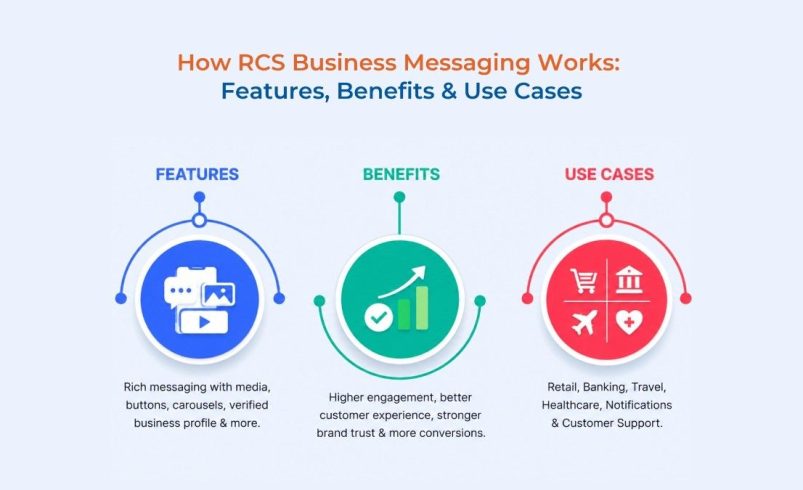
Summary – RCS Business Messaging (RBM) is a next-generation messaging solution that helps businesses communicate with customers through richer, more interactive conversations. It upgrades traditional SMS by adding features like images, videos, buttons, product cards, verified business profiles, chatbots, and two-way conversations.
Simply put, RCS brings an app-like messaging experience directly into a customer’s default messaging app.
For example, instead of sending a simple SMS saying:
“Your order has been shipped.”
A business can send an interactive message that includes:
- Company branding
- Product images
- Delivery tracking buttons
- Customer support options
- Quick replies
Customers can complete actions directly from the message without opening multiple apps or websites.
RCS Business Messaging works by connecting businesses with customers through mobile networks, messaging platforms, and communication APIs. When a customer has an RCS-supported device and network connection, they can interact with businesses using advanced messaging features.
For companies looking to improve engagement, customer experience, and conversions, RCS combines the wide reach of SMS with the interactive experience customers expect from modern communication platforms.
What Is RCS Business Messaging?
RCS stands for Rich Communication Services, a messaging standard created to improve the limitations of traditional SMS and MMS.
RCS Business Messaging is the business-focused version of RCS that allows companies to create more engaging conversations with their customers.
Traditional SMS mainly allows businesses to send text messages. RCS adds advanced communication features that make messages more useful and interactive.
For example, a business can send:
- Verified company information
- Images and videos
- Product details
- Booking options
- Payment links
- Customer support interactions
A real estate company in Mumbai, for instance, can share property images, project details, virtual tour links, and a site visit booking option directly through an RCS conversation.
This creates a smoother customer journey and helps businesses connect with customers in a more meaningful way.
How Does RCS Business Messaging Work?
RCS Business Messaging works through a combination of telecom networks, messaging platforms, and business communication systems.
Here is how the process works:
1. A Business Creates an RCS Profile
The first step is creating a verified business profile.
This profile includes important business details such as:
- Brand name
- Logo
- Business information
- Verification details
- Contact information
This helps customers identify that they are communicating with a genuine business instead of an unknown sender.
2. The Business Connects Through an RCS Platform
Businesses usually use messaging platforms or communication providers to connect their systems with RCS.
These platforms help businesses manage:
- Customer conversations
- Automated messages
- Campaigns
- API integrations
- Analytics
This allows companies to send personalized communication at scale.
3. Customers Receive Interactive Messages
When customers use an RCS-supported messaging application, they can receive advanced messages with interactive features.
They can:
- Reply directly
- Click buttons
- View media
- Ask questions
- Complete actions
The experience feels closer to using a chat-based application rather than receiving a traditional SMS.
4. Businesses Track Customer Engagement
One of the major benefits of RCS is better visibility into customer interactions.
Businesses can monitor:
- Message delivery
- Read status
- Customer responses
- Engagement levels
These insights help brands improve future communication campaigns.
Key Features of RCS Business Messaging
RCS is designed to make business communication more interactive, personal, and convenient.
Branded Business Profiles
A major advantage of RCS is that businesses can communicate through verified profiles.
Customers can see:
- Official business name
- Company logo
- Verified sender identity
This builds trust, especially for industries like banking, healthcare, and financial services where customers need confidence before engaging.
Rich Media Messaging
Unlike SMS, RCS supports visual communication.
Businesses can share:
- Product images
- Videos
- Promotional content
- Service information
- Location details
For example, an e-commerce brand can showcase products visually instead of relying only on text descriptions.
Interactive Buttons and Actions
RCS allows businesses to add clickable options inside messages.
Examples include:
- Track Order
- Book Appointment
- Call Now
- Visit Website
- Get Directions
These features reduce customer effort and make it easier for users to take action.
Two-Way Customer Conversations
RCS allows businesses and customers to have real conversations.
Customers can ask questions, request information, or get support without moving to another platform.
This creates a better communication experience compared to one-way promotional messages.
AI Chatbots and Automation
Businesses can combine RCS with AI-powered chatbots to handle common customer requests.
Examples include:
- Checking order status
- Answering FAQs
- Scheduling appointments
- Sharing product information
When a customer needs more help, human agents can take over the conversation.
Analytics and Customer Insights
RCS provides businesses with valuable performance data.
Companies can analyze:
- Delivery rates
- Customer engagement
- Response patterns
- Campaign performance
These insights help businesses create more effective communication strategies.
RCS Business Messaging vs SMS: What Is the Difference?
|
Feature |
SMS |
RCS Business Messaging |
|
Text messages |
Yes |
Yes |
|
Brand profile |
No |
Yes |
|
Images and videos |
Limited |
Yes |
|
Interactive buttons |
No |
Yes |
|
Chatbots |
No |
Yes |
|
Two-way conversations |
Basic |
Advanced |
|
Analytics |
Limited |
Detailed |
|
Verification |
No |
Yes |
SMS remains useful because it works across almost all mobile devices. However, RCS provides a richer experience for businesses that want more engaging customer interactions.
Many companies use SMS and RCS together depending on their communication goals and customer preferences.
Benefits of RCS Business Messaging for Businesses
Higher Customer Engagement
Customers are more likely to interact with messages that provide useful actions and visual information.
A message with product images, buttons, and quick replies creates a more engaging experience than a basic text message.
Better Customer Experience
Customers today expect fast and convenient communication.
RCS helps businesses provide smoother experiences by allowing customers to:
- Track orders
- Confirm appointments
- Get support
- Explore products
without leaving the conversation.
Improved Conversion Rates
RCS helps businesses create complete customer journeys within messaging.
For example:
A retail business can:
- Recommend a product
- Show product images
- Provide buying options
- Send confirmation updates
This reduces friction and increases the chances of conversion.
Reduced Customer Support Costs
Automated RCS conversations can manage repetitive customer requests.
Businesses can handle large communication volumes while allowing support teams to focus on more complex customer issues.
Stronger Brand Trust
Verified business profiles help customers recognize legitimate brands.
This is especially important in regions like India, where customers are becoming more careful about spam messages and digital fraud.
How Businesses Use RCS Business Messaging Across Industries?
Banking and Financial Services
Banks use RCS for:
- Transaction notifications
- Fraud alerts
- Payment reminders
- Account updates
- Customer support
Instead of receiving a basic alert, customers can interact with a verified banking message.
Retail and E-commerce
Retail brands use RCS for:
- Product promotions
- Cart recovery campaigns
- Order updates
- Delivery alerts
- Customer feedback
For example, an online shopping company can send personalized product suggestions with direct action buttons.
Healthcare
Healthcare organizations use RCS for:
- Appointment reminders
- Patient updates
- Prescription notifications
- Healthcare communication
This improves patient engagement and reduces missed appointments.
Travel and Hospitality
Travel businesses use RCS for:
- Booking confirmations
- Flight updates
- Hotel details
- Customer assistance
Customers can receive important travel information in one convenient conversation.
Real Estate
Real estate companies use RCS to improve customer engagement through:
- Property promotion
- Project updates
- Virtual tours
- Site visit scheduling
Potential buyers can explore properties and connect with sales teams more easily.
Education
Educational institutions use RCS for:
- Admission notifications
- Course information
- Student updates
- Event reminders
Telecom Industry
Telecom companies use RCS for:
- Recharge reminders
- Plan suggestions
- Service updates
- Customer support
Choosing the Right RCS Service Provider
Businesses generally work with an experienced RCS service Provider to implement messaging solutions effectively.
A reliable provider helps businesses manage:
- RCS API integration
- Business verification
- Message campaigns
- Customer communication workflows
- Performance tracking
When selecting an RCS partner, businesses should consider:
- Platform reliability
- Industry experience
- Security practices
- Integration support
- Network reach
The success of an RCS strategy depends not only on the technology but also on choosing the right communication approach for customers.
Best Practices for Successful RCS Business Messaging
Focus on Personalized Communication
Customers respond better when messages are relevant.
Businesses can improve engagement by using:
- Customer preferences
- Previous interactions
- Purchase behavior
Keep Messages Clear and Action-Focused
Every message should have a clear goal.
Examples:
- Complete payment
- Schedule a meeting
- Track delivery
- Contact support
Use Rich Media Where It Adds Value
Images, videos, and interactive elements should improve the customer experience rather than create unnecessary distractions.
Balance Automation With Human Support
Automation improves speed, but human assistance remains important for complex situations.
The strongest customer experiences combine both.
Maintain Customer Privacy
Businesses should always follow communication regulations and respect customer preferences.
Trust is essential for long-term customer relationships.
Challenges of RCS Business Messaging
While RCS provides many advantages, businesses should also understand its limitations.
Device and Network Availability
RCS availability depends on:
- Mobile networks
- Device compatibility
- Messaging applications
Not every customer may have access to RCS.
Customer Adoption
Businesses should continue supporting alternative channels based on customer needs.
Implementation Requirements
A successful RCS setup requires:
- Technical integration
- Proper planning
- Messaging strategy
Future of RCS Business Messaging
RCS is becoming an important part of conversational customer communication.
Future improvements are expected to include:
- More AI-powered interactions
- Smarter personalization
- Better automation
- Stronger CRM integrations
As businesses focus more on customer experience, RCS provides a way to create faster, more interactive, and more personalized conversations.
Start Building Better Customer Conversations With RCS
RCS Business Messaging helps businesses move beyond simple notifications and create meaningful customer conversations. From improving customer support to increasing engagement and conversions, RCS provides a modern way to communicate with customers through a channel they already use.
If your business is planning to adopt RCS, working with the right technology partner can help you design the right messaging strategy, integration process, and customer communication workflow. A well-executed RCS approach can help your brand deliver faster, smarter, and more personalized customer experiences.
Frequently Asked Questions About RCS Business Messaging
What is RCS Business Messaging?
RCS Business Messaging is a messaging solution that allows businesses to send interactive, branded messages with rich media, buttons, and two-way conversations.
How is RCS different from SMS?
SMS supports basic text communication, while RCS adds features like images, videos, verified profiles, interactive buttons, and advanced conversations.
Can businesses use AI chatbots with RCS?
Yes. Businesses can integrate AI chatbots with RCS to automate customer support and handle common queries.
Is RCS useful for small businesses?
Yes. Small businesses can use RCS for promotions, customer updates, appointment reminders, and customer engagement.
Which industries benefit from RCS?
Banking, retail, healthcare, travel, education, real estate, and telecom industries can benefit from RCS Business Messaging.
How can businesses start using RCS?
Businesses can start by selecting an RCS platform partner, creating a verified profile, integrating communication systems, and building messaging workflows.