

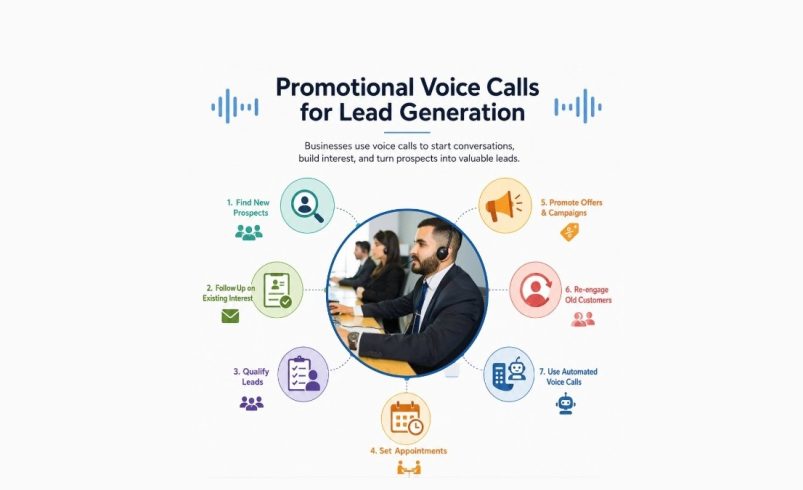
Summary – Promotional voice calls are automated or assisted marketing calls used by businesses to connect with potential customers, promote products or services, qualify prospects, and generate sales opportunities. Companies use voice campaigns to reach targeted audiences, deliver personalized messages, collect customer responses, and move leads faster through the sales funnel.
Unlike traditional cold calling, modern promotional voice call campaigns use AI voice technology, cloud telephony, CRM integration, and automated workflows to improve customer engagement while reducing operational costs. Industries such as banking, real estate, healthcare, education, e-commerce, and travel use promotional voice calls to create direct conversations with customers and increase conversions.
Generating quality leads has become more challenging as customers receive thousands of digital marketing messages every day. Emails may remain unopened, advertisements may be ignored, and text messages may not always create meaningful engagement.
Promotional voice calls provide businesses with a direct communication channel where brands can speak with potential customers, understand their needs, and guide them toward the next step.
From startups to large enterprises, companies are using voice-based marketing campaigns to improve customer acquisition, increase response rates, and create personalized customer journeys.
What Are Promotional Voice Calls?
Promotional voice calls are outbound marketing calls made by businesses to promote products, services, offers, events, or solutions to potential customers.
These calls can be:
- Automated voice calls using AI voice bots
- Pre-recorded promotional messages
- Interactive IVR campaigns
- Sales assistance calls
- Lead qualification calls
The main objective is not only to deliver a message but also to encourage customer action, such as:
- Booking a demo
- Requesting a callback
- Visiting a website
- Scheduling an appointment
- Making a purchase decision
For example, a real estate company launching a new housing project in Mumbai may use promotional voice calls to inform interested buyers about property availability, pricing, and site visit options.
Why Do Businesses Choose Promotional Voice Calls for Lead Generation?
1. Voice Creates a More Personal Customer Connection
Customers often respond better when communication feels human.
A voice interaction allows businesses to:
- Explain product benefits clearly
- Answer basic customer questions
- Create trust faster
- Understand customer interest level
For industries where buying decisions require trust, such as financial services, healthcare, and real estate, voice communication plays an important role.
2. Faster Lead Qualification
One of the biggest advantages of promotional voice campaigns is identifying high-intent prospects quickly.
Instead of collecting thousands of unqualified leads, businesses can ask customers:
- Are you interested in this service?
- When are you planning to purchase?
- What type of solution are you looking for?
The responses help sales teams focus on customers who are more likely to convert.
For example:
An education company promoting online courses can use automated voice calls to identify students interested in specific programs and connect them with counselors.
3. Better Reach Compared to Text-Based Marketing
Many customers may ignore promotional emails or messages, but voice communication creates immediate attention.
Businesses use promotional voice calls because they provide:
- Faster communication
- Higher visibility
- Real-time customer interaction
- Better engagement opportunities
This is especially useful for regional campaigns where customers prefer communication in local languages.
How Promotional Voice Call Campaigns Work?
Step 1: Identify the Right Target Audience
Successful voice campaigns start with proper audience segmentation.
Businesses analyze:
- Customer demographics
- Previous inquiries
- Purchase behavior
- Geographic location
- Customer interests
For example, a healthcare provider in Delhi may target customers who previously searched for health packages or appointment services.
Step 2: Create a Customer-Focused Voice Script
A good promotional voice script should focus on customer needs instead of only selling.
A strong script includes:
- Introduction
- Reason for calling
- Value proposition
- Clear action
Example:
“Hello, we are calling to inform you about our new business loan options designed for small businesses. Press 1 to speak with our advisor.”
The message should be short, relevant, and easy to understand.
Step 3: Use Automation and AI Voice Technology
Modern businesses use:
- AI voice assistants
- Automated dialing systems
- Speech recognition
- CRM integrations
- Call analytics
These technologies allow companies to manage thousands of customer conversations efficiently.
Step 4: Capture and Follow Up With Leads
A promotional voice call should not end after delivering information.
Businesses can collect:
- Customer interest
- Contact preferences
- Product requirements
- Appointment requests
These leads can then move into CRM systems for sales follow-up.
Types of Promotional Voice Call Campaigns Businesses Use
Product Promotion Calls
Businesses use voice calls to introduce:
- New products
- Special offers
- Seasonal promotions
- Service upgrades
Example:
An e-commerce company may inform customers about a festival sale or new product launch.
Sales Follow-Up Calls
Many businesses lose potential customers because inquiries are not followed up quickly.
Voice campaigns help reconnect with:
- Website visitors
- Demo requests
- Previous customers
- Abandoned inquiries
Appointment Booking Calls
Industries like healthcare, education, and consulting use promotional voice calls to schedule appointments.
Examples:
- Doctor consultation booking
- Course counseling sessions
- Property visits
Customer Survey and Feedback Calls
Voice campaigns also help businesses understand customer expectations.
Companies collect feedback about:
- Product experience
- Service quality
- Customer satisfaction
Industry-Wise Use Cases of Promotional Voice Calls
Banking and Financial Services
Banks and financial companies use promotional voice calls for:
- Loan promotions
- Credit card offers
- Insurance awareness
- Financial product updates
Voice communication helps explain complex financial products more clearly.
Real Estate Industry
Real estate businesses use voice campaigns for:
- New project promotions
- Buyer qualification
- Site visit scheduling
- Lead nurturing
A developer in cities like Mumbai, Pune, Bengaluru, or Delhi can reach potential buyers faster through targeted voice campaigns.
Healthcare Industry
Healthcare organizations use voice marketing for:
- Health packages
- Consultation services
- Appointment scheduling
Voice calls provide a convenient communication method for patients.
Education and Training Industry
Educational institutes use promotional voice calls for:
- Course promotions
- Admission campaigns
- Student counseling
E-commerce and Retail
Retail brands use voice calls for:
- Product launches
- Discount announcements
- Customer retention campaigns
Promotional Voice Calls vs Other Lead Generation Channels
Voice Calls vs SMS Marketing
SMS delivers information quickly, but voice calls create interaction.
SMS is useful for:
- Alerts
- Short updates
Voice calls are useful for:
- Conversations
- Lead qualification
- Sales engagement
Voice Calls vs Email Marketing
Emails require customers to open and read messages.
Voice calls provide direct communication and faster responses.
Voice Calls vs Traditional Cold Calling
Traditional calling depends heavily on manual sales teams.
Modern promotional voice campaigns offer:
- Automation
- Better scalability
- Detailed analytics
- Lower operational effort
Best Practices for Successful Promotional Voice Call Campaigns
Keep Messages Short and Relevant
Customers respond better to clear communication.
Avoid long promotional messages.
Personalize Customer Conversations
Use customer information to create relevant experiences.
Examples:
- Mention previous interest
- Recommend suitable products
- Provide location-based offers
Choose the Right Calling Time
Timing impacts customer response.
Businesses should consider:
- Customer behavior
- Regional preferences
- Business hours
Maintain Compliance Standards
Businesses running promotional voice campaigns should follow telecom regulations and customer consent requirements.
In India, organizations should consider DLT-related compliance practices for commercial communication campaigns.
How Outbound Voice Calls Services Help Businesses Generate Better Leads?
Businesses looking to scale customer acquisition often use professional outbound communication solutions.
With Outbound Voice Calls Services, companies can automate promotional campaigns, reach targeted audiences, qualify leads, and connect interested customers with sales teams.
These services help organizations manage large-scale calling campaigns with features such as:
- Automated dialing
- Voice broadcasting
- IVR-based customer responses
- Call tracking
- CRM integration
- Campaign reporting
For businesses operating across regions like Mumbai, Bengaluru, Delhi, Hyderabad, and other Indian markets, outbound voice solutions can support localized customer engagement strategies.
Role of AI in Promotional Voice Call Marketing
Artificial intelligence is improving how businesses communicate with customers.
AI-powered voice solutions can:
- Understand customer responses
- Provide automated assistance
- Personalize conversations
- Identify buying intent
- Route qualified leads to sales teams
This allows businesses to combine automation with human-like customer experiences.
How Businesses Measure Promotional Voice Call Success?
Companies track campaign performance using metrics such as:
- Call connection rate
- Customer response rate
- Lead conversion rate
- Cost per lead
- Sales generated
- Appointment bookings
These insights help businesses improve future campaigns.
Common Challenges Businesses Face With Promotional Voice Calls
Customer Call Fatigue
Too many calls can negatively impact customer experience.
Solution:
Use targeted campaigns and meaningful messaging.
Low Engagement
Generic scripts often fail.
Solution:
Improve personalization and customer relevance.
Maintaining Quality at Scale
Large campaigns require proper technology.
Solution:
Use reliable voice platforms with analytics and automation.
Future of Promotional Voice Calls for Lead Generation
The future of voice marketing will focus on smarter conversations, better personalization, and AI-powered customer engagement.
Businesses will increasingly combine:
- AI voice assistants
- CRM automation
- Customer data analysis
- Omnichannel marketing
Voice will continue to remain an important channel for businesses that want direct and meaningful customer conversations.
Generate More Qualified Leads With Strategic Voice Campaigns
Promotional voice calls are no longer limited to simple marketing messages. When combined with automation, personalization, and customer insights, they become a powerful lead generation tool.
Businesses that want to improve customer acquisition, increase sales opportunities, and build stronger customer connections can start by creating targeted voice campaigns designed around their audience.
Partnering with the right voice communication provider can help businesses launch scalable campaigns, improve conversions, and turn conversations into measurable business growth.
Frequently Asked Questions
What are promotional voice calls used for?
Promotional voice calls are used for marketing products, generating leads, promoting services, qualifying customers, and increasing sales opportunities.
Are promotional voice calls effective for lead generation?
Yes. When properly targeted and personalized, promotional voice calls can improve customer engagement and help businesses identify high-quality leads faster.
Which industries benefit from promotional voice calls?
Industries including banking, real estate, healthcare, education, retail, and travel commonly use promotional voice campaigns.
How do AI voice calls help businesses?
AI voice calls help automate customer conversations, collect responses, qualify leads, and reduce manual calling efforts.
Can small businesses use promotional voice calls?
Yes. Small businesses can use voice campaigns to reach local customers, promote services, and generate new inquiries without investing in large sales teams.