



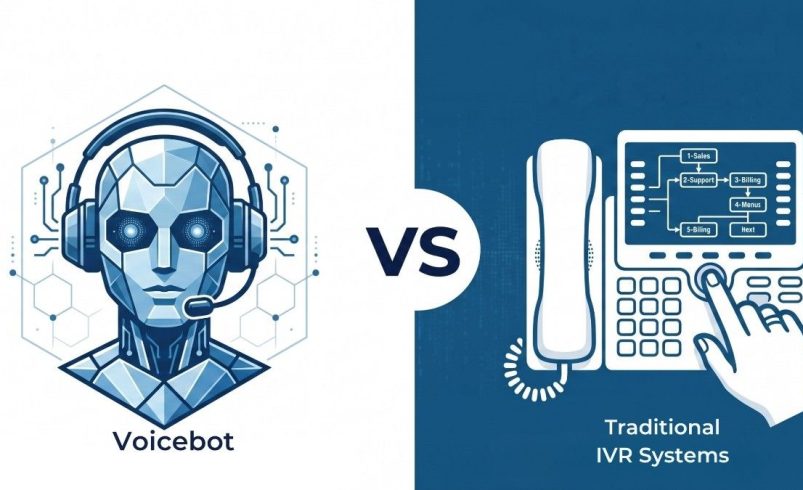
Summary – AI Voice Bots and Traditional IVR systems both help businesses automate customer communication, but the way they work is completely different. Traditional IVR relies on fixed menus and pre-recorded messages, while AI Voice Bots use artificial intelligence, speech recognition, and natural language processing to understand customer conversations and respond intelligently.
For businesses that want faster support, better customer experiences, and smarter automation, AI Voice Bots are becoming a preferred choice. However, traditional IVR systems are still useful for businesses that only need basic call routing and simple self-service options.
The right solution depends on factors such as business goals, customer expectations, call volume, and the level of automation required.
Customer conversations play a major role in building trust and maintaining strong business relationships. Whether it is a bank helping customers with account-related questions, a healthcare provider managing appointments, or an e-commerce company providing order updates, phone communication continues to be one of the most effective customer service channels.
For many years, businesses depended on Traditional IVR systems to handle customer calls. Customers were guided through automated options like “Press 1 for sales” or “Press 2 for support.” These systems helped companies manage large numbers of calls and reduce pressure on support teams.
However, customer expectations have changed significantly.
People today want quick answers, personalized conversations, and solutions without spending several minutes navigating through multiple menu options.
This shift has increased the adoption of AI Voice Bots. These intelligent voice solutions can understand customer intent, respond naturally, and complete tasks automatically.
But does this mean traditional IVR has lost its importance?
Not completely.
Many businesses still use IVR effectively for simple processes, while others are moving toward AI-powered voice automation for more advanced customer interactions.
The best choice depends on what a business wants to achieve with its communication strategy.
What Is a Traditional IVR System?
A Traditional IVR (Interactive Voice Response) system is an automated calling technology that allows customers to interact with a business through voice instructions or keypad selections.
A simple IVR journey usually works like this:
- A customer calls the business number
- An automated voice menu provides different options
- The customer selects an option using keypad input
- The call is directed to the relevant department
For example:
“Press 1 for sales”
“Press 2 for customer support”
“Press 3 for billing information”
Traditional IVR systems are commonly used by industries such as banking, telecom, insurance, and large enterprises because they can handle a high number of calls at the same time.
Key Benefits of Traditional IVR Systems
1. Handles Large Call Volumes
Businesses receiving thousands of customer calls can use IVR to organize incoming calls and manage customer requests efficiently without increasing support staff.
2. Provides 24/7 Customer Availability
Customers can access basic information and services even outside regular business hours.
3. Helps Reduce Support Costs
By automating repetitive queries, IVR reduces the workload on customer service teams.
4. Improves Call Routing
A well-designed IVR system helps customers reach the right department quickly, especially when the query is simple and predictable.
Limitations of Traditional IVR Systems
Although traditional IVR has been valuable for many years, it also comes with certain challenges.
Limited Understanding of Customer Needs
Traditional IVR follows predefined paths. It can only respond to options that have already been programmed.
For example, if a customer says:
“I want to understand why my payment failed yesterday.”
A traditional IVR may not understand the request unless a matching option is available.
Complex Menus Can Frustrate Customers
Long IVR menus often create a poor customer experience because users have to listen to multiple options before finding the right solution.
Limited Personalization
Most traditional IVR systems provide the same experience to every customer, regardless of their previous interactions with the business.
What Is an AI Voice Bot?
An AI Voice Bot is an intelligent voice automation solution that uses artificial intelligence, speech recognition, machine learning, and natural language processing to communicate with customers.
Unlike traditional IVR, AI Voice Bots can understand normal conversations and identify what the customer actually needs.
For example:
Customer:
“I want to update my delivery address.”
AI Voice Bot:
“Sure, I can help you update your delivery details. Let me verify your order information first.”
This creates a smoother and more natural conversation experience.
How AI Voice Bots Work?
AI Voice Bots combine multiple technologies to deliver intelligent customer interactions.
Speech Recognition
Converts human speech into data that the system can understand.
Natural Language Processing (NLP)
Helps the AI understand customer intent, context, and meaning.
Machine Learning
Allows the system to improve its responses based on previous interactions.
Business System Integration
AI Voice Bots can connect with CRM platforms, databases, payment systems, and other business applications.
Benefits of AI Voice Bots for Businesses
1. Creates Human-Like Conversations
AI Voice Bots allow customers to communicate naturally instead of following fixed menu options.
2. Provides Faster Resolutions
Customers receive immediate responses without waiting for an available support representative.
3. Delivers Personalized Customer Experiences
AI systems can use customer information to provide more relevant responses.
For example:
A banking AI Voice Bot can verify a customer and provide account-related assistance based on their information.
4. Supports Business Growth
AI Voice Bots can handle increasing call volumes without requiring businesses to continuously expand their support teams.
5. Automates Repetitive Tasks
Customer support teams can focus on complex issues while AI manages regular requests.
AI Voice Bots vs Traditional IVR: Key Differences
Customer Interaction Experience
Traditional IVR:
Provides fixed options and recorded responses.
AI Voice Bots:
Understand natural conversations and respond based on customer intent.
Query Handling Capability
Traditional IVR:
Works best for basic requests and simple call routing.
AI Voice Bots:
Can manage detailed conversations and multi-step customer requirements.
Personalization Level
Traditional IVR:
Offers standard responses.
AI Voice Bots:
Creates personalized interactions using customer information.
Learning Ability
Traditional IVR:
Requires manual updates whenever changes are needed.
AI Voice Bots:
Continuously improve through AI-based learning.
Integration Capability
Traditional IVR:
Provides limited automation options.
AI Voice Bots:
Can connect with CRM systems, databases, ticketing platforms, and business tools.
Real-World Business Applications of AI Voice Bots
Banking Industry
Banks use AI Voice Bots for:
- Customer verification
- Account-related queries
- Payment reminders
- Transaction support
This helps reduce call center workload and improves customer response time.
Healthcare Industry
Healthcare providers use AI voice automation for:
- Appointment scheduling
- Patient reminders
- Follow-up communication
E-commerce Industry
Online businesses use AI Voice Bots for:
- Order tracking
- Delivery updates
- Customer support assistance
Travel and Hospitality Industry
Businesses use voice automation for:
- Booking support
- Reservation updates
- Customer notifications
How AI Voice Bots Improve Outbound Customer Communication?
Outbound calling plays an important role in customer engagement, sales follow-ups, reminders, and business notifications.
Businesses use automated voice solutions for:
- Appointment reminders
- Customer feedback collection
- Payment reminders
- Lead follow-ups
- Promotional communication
Companies looking to improve customer outreach and automate large-scale calling activities can use Outbound Voice Calls Services to create faster and more personalized customer interactions.
AI-powered outbound calling helps businesses improve efficiency while reducing the need for manual calling efforts.
Can AI Voice Bots Replace Traditional IVR Completely?
AI Voice Bots are becoming more advanced, but traditional IVR still has its place.
Many businesses are adopting a hybrid approach where:
- Traditional IVR manages basic call routing
- AI Voice Bots handle intelligent conversations
- Human agents manage complex or sensitive customer issues
This approach allows businesses to maintain automation while still providing human support when required.
Which Is Better for Businesses: AI Voice Bots or Traditional IVR?
The right choice depends on business needs.
Traditional IVR may be suitable when:
- The business requires simple call routing
- Customer queries are predictable
- Basic automation is enough
AI Voice Bots are a better option when:
- Businesses receive high call volumes
- Customer experience is a priority
- Intelligent automation is required
- Personalized communication is important
For businesses operating in regions like India, where customer communication often involves multiple languages and diverse customer needs, AI Voice Bots offer a scalable way to improve customer engagement.
How Businesses Can Select the Right Voice Automation Solution?
Before choosing a solution, businesses should evaluate:
Customer Expectations
Understand how customers prefer to communicate and receive support.
Call Volume
Businesses handling large numbers of calls can benefit more from AI automation.
Integration Requirements
The solution should connect smoothly with existing business systems.
Security and Compliance
Customer information should be handled securely.
Future Scalability
The technology should support business growth.
Future of Business Communication With AI Voice Technology
Voice automation is moving beyond basic call management.
Businesses are focusing on:
- Personalized customer conversations
- Faster issue resolution
- Multilingual support
- Intelligent automation
- Better collaboration between humans and AI
Companies adopting advanced voice solutions can improve customer satisfaction while creating more efficient communication processes.
Building Smarter Customer Communication With AI Voice Automation
Traditional IVR systems continue to serve businesses that need simple automation and structured call handling. However, businesses aiming for better customer experiences and intelligent communication are increasingly moving toward AI Voice Bots.
With the ability to understand conversations, automate tasks, and deliver personalized interactions, AI Voice Bots help businesses create stronger customer relationships while improving operational efficiency.
If your business is planning to modernize customer communication, reduce manual calling efforts, or build a smarter voice automation strategy, connect with a voice technology expert and explore the right solution based on your business goals.
Frequently Asked Questions
What is the difference between AI Voice Bots and Traditional IVR?
Traditional IVR uses fixed menus, while AI Voice Bots understand natural conversations and provide intelligent responses.
Are AI Voice Bots better than IVR?
For businesses looking for advanced automation and better customer experiences, AI Voice Bots provide more flexibility.
Can AI Voice Bots handle customer service calls?
Yes. AI Voice Bots can manage many customer service activities including FAQs, reminders, scheduling, and support requests.
Do AI Voice Bots replace customer support agents?
No. They assist support teams by handling repetitive tasks while human agents manage complex situations.
Are AI Voice Bots costly?
The cost depends on business requirements, call volume, features, and integrations.
Which industries benefit from AI Voice Bots?
Industries such as banking, healthcare, e-commerce, education, travel, and customer service can benefit from AI voice automation.