




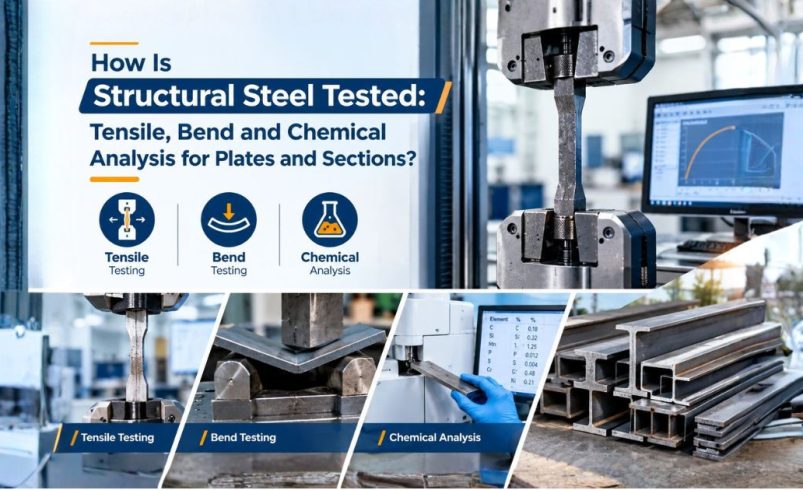
Summary – Structural steel is tested to verify its strength, ductility, chemical composition, and compliance with the applicable material specification. Three important testing methods are tensile testing, bend testing, and chemical analysis. Tensile testing measures properties such as yield strength and ultimate tensile strength, bend testing evaluates the steel’s ability to withstand deformation, and chemical analysis checks the percentages of specified elements. Together, these tests help engineers, contractors, and fabricators make informed decisions about steel quality before structural components are approved for use.
Structural steel is widely used in industrial buildings, warehouses, commercial structures, bridges, factories, and infrastructure projects. However, steel that looks satisfactory on the surface may not necessarily meet the mechanical and chemical requirements specified for its intended application.
Structural steel testing helps verify whether supplied plates, beams, channels, angles, and other sections conform to the required grade and product specification. It also supports material traceability, procurement quality control, and compliance with project requirements.
For example, when a contractor receives steel plates for fabricating an industrial shed, the material test certificate (MTC) may state the steel grade and mechanical properties. Checking the certificate against the actual delivery identification and arranging independent testing when required can help identify discrepancies before fabrication begins.
The objective is not simply to test steel, but to establish whether the material is suitable for its specified purpose.
How Is Structural Steel Tested?
Structural steel is commonly evaluated through mechanical tests and chemical analysis. The specific tests depend on the steel grade, product form, applicable standards, purchase order, and project inspection plan.
1. How Is a Tensile Test Performed on Structural Steel?
A tensile test determines how steel behaves when it is subjected to a gradually increasing pulling force. It helps establish important mechanical properties, including yield strength, ultimate tensile strength, and percentage elongation.
The procedure generally involves the following steps:
- Sample selection: A representative sample is selected from the relevant steel plate, section, or material batch.
- Specimen preparation: The test specimen is machined or prepared according to the applicable standard.
- Initial measurements: The specimen dimensions and gauge length are recorded.
- Machine setup: The specimen is secured in a calibrated universal testing machine (UTM).
- Load application: Tensile force is applied under the prescribed testing conditions.
- Result recording: The machine records the load and deformation until the required properties are determined and the specimen fractures.
The results are compared with the acceptance limits applicable to the specified steel grade and product dimensions.
Why does tensile testing matter?
Yield strength indicates the stress at which significant permanent deformation begins, while ultimate tensile strength represents the maximum tensile stress reached during the test. Elongation provides an indication of ductility.
These properties help engineers assess whether structural steel satisfies the specified mechanical requirements. For instance, a steel plate intended for a load-bearing connection must meet the relevant grade requirements rather than being accepted solely because its appearance is satisfactory.
2. What Is the Bend Test for Structural Steel?
A bend test evaluates a steel specimen’s ability to undergo a specified degree of bending without developing unacceptable cracks or other signs of failure.
During the test, the specimen is bent around a specified former or mandrel using the prescribed arrangement. The bending angle, former dimensions, specimen preparation, and acceptance requirements depend on the applicable test standard and product specification.
The test can help reveal whether the material tolerates the required deformation under the test conditions.
Bend testing may be specified for certain steel products, grades, or fabrication-related quality checks. It is particularly relevant when ductility under bending is an important material requirement.
However, a bend test does not independently establish the complete structural performance of a steel component. It should be interpreted alongside the other required tests and applicable acceptance criteria.
3. How Is Chemical Analysis of Structural Steel Conducted?
Chemical analysis determines the concentration of specified elements in a steel sample. It helps verify material composition against the requirements for the declared grade.
Commonly assessed elements include:
- Carbon: Influences strength, hardness, and weldability.
- Manganese: Contributes to strength and other mechanical characteristics.
- Silicon: Plays a role in steelmaking and can influence strength.
- Sulphur and phosphorus: Controlled within specified limits because excessive levels can adversely affect steel properties.
- Chromium, nickel, and other alloying elements: Tested when relevant to the material grade and specification.
Optical emission spectroscopy (OES) is one method used for determining the chemical composition of steel. Other validated analytical methods may be appropriate depending on the element being measured and the required accuracy.
For example, if the delivered steel is declared as a particular structural grade, chemical analysis can help assess whether its composition matches the relevant specification. Nevertheless, chemical composition alone does not prove that the material meets all mechanical requirements.
Which Indian Standards Apply to Structural Steel Testing?
Structural steel testing in India should follow the applicable product specification and test methods. Important standards include:
- IS 2062: Covers requirements for hot-rolled structural steel products. The applicable edition, part, amendments, and grade must be verified for the material being tested.
- IS 1608 (Part 1):2018: Specifies the tensile testing method for metallic materials at room temperature.
- IS 1599:2023: Covers the bend test for metallic materials.
- IS 228 series: Provides methods for chemical analysis of steel, with the relevant part depending on the element and analytical procedure.
The correct standard depends on the product and testing requirement. A structural steel plate, for example, may have different sampling or acceptance provisions from another product form.
Before arranging testing, check the project specification, purchase order, applicable standard, material grade, and any required inspection documentation. Always verify the current edition and amendments before relying on a standard for acceptance decisions.
What Is the Difference Between Tensile Testing, Bend Testing, and Chemical Analysis?
Each test evaluates a different aspect of steel quality.
|
Testing method |
What it evaluates |
Typical results |
|
Tensile testing |
Mechanical strength and deformation |
Yield strength, tensile strength, elongation |
|
Bend testing |
Behaviour under prescribed bending |
Cracking or other unacceptable indications |
|
Chemical analysis |
Elemental composition |
Percentage of specified elements |
These methods complement one another. A steel sample may satisfy chemical composition limits but fail to meet a mechanical requirement. Similarly, satisfactory tensile results do not automatically establish compliance with every chemical or bend-test requirement.
The appropriate combination of tests provides a more complete basis for material verification.
How Should Structural Steel Test Reports Be Checked?
A test report is useful only when its results can be linked to the correct material and evaluated against the correct requirements.
Before approving steel for fabrication, check the following:
- Material identification: Confirm the grade, heat number, batch identification, and product dimensions.
- Applicable standards: Verify that the reported test methods match the project requirements.
- Mechanical properties: Compare tensile and bend-test results with the specified acceptance criteria.
- Chemical composition: Check the reported elements against the limits for the relevant grade.
- Traceability: Match the report with the material test certificate and delivery records.
- Laboratory details: Review the testing laboratory’s competence, equipment, and relevant accreditation scope where applicable.
Consider a delivery in which the MTC identifies one steel grade, but the heat number on the supplied material does not match the documentation. The responsible quality-control team should investigate the discrepancy before approving the material.
A mismatch does not automatically prove that the steel is defective, but it does mean that traceability needs to be resolved.
What Factors Can Affect Structural Steel Test Results?
Reliable testing depends on appropriate sampling, specimen preparation, equipment, and procedures.
Common factors include:
- Selecting a sample that does not represent the supplied batch.
- Preparing specimens incorrectly or using unsuitable dimensions.
- Failing to account for the required specimen orientation.
- Using equipment that is not properly calibrated or maintained.
- Applying an incorrect test procedure.
- Misidentifying samples or losing traceability between the material and report.
- Comparing results against the wrong grade or acceptance criteria.
These issues can lead to unreliable conclusions. Clear sampling procedures, controlled laboratory practices, and complete documentation help improve confidence in the results.
How Do Construction Material Testing Services Support Steel Quality Control?
Professional construction material testing services help contractors, fabricators, developers, and project consultants verify that construction materials meet the relevant technical requirements.
For structural steel, the required testing programme may include tensile testing, bend testing, chemical analysis, and other evaluations specified by the project. The selection should be based on the material grade, product type, intended application, and contractual requirements.
In industrial and infrastructure projects across Pune, Mumbai, and other parts of Maharashtra, material verification can be particularly useful when several steel suppliers, fabrication units, and construction teams are involved. Consistent documentation helps connect material deliveries with inspection records and approval decisions.
When selecting a testing provider, confirm that it has the appropriate equipment, competent personnel, validated test methods, and experience with the relevant product forms. Where NABL accreditation is required, check that the specific test is included in the laboratory’s current accredited scope. Understanding NABL accreditation for testing can also help project teams make informed decisions when choosing a testing laboratory.
A testing report should provide clear results and sufficient identification details to support the project’s quality-control process. It should not be treated as a blanket guarantee of structural safety, which also depends on design, fabrication, connections, erection, and inspection.
What Are the Benefits of Testing with an NABL Accredited Laboratory?
Verify Structural Steel Before Fabrication Begins
Steel quality should be established through appropriate testing, traceable documentation, and comparison with the correct acceptance criteria—not appearance or certificates alone. Whether you are procuring structural plates for an industrial building or sections for an infrastructure project, confirm the applicable testing requirements before the material enters fabrication.
Review your steel grade, material certificates, and project specifications, then consult a qualified material testing laboratory to determine the appropriate tensile, bend, and chemical analysis requirements for your next construction project.
Frequently Asked Questions About Structural Steel Testing
How is structural steel tested in India?
Structural steel is tested using methods such as tensile testing, bend testing, and chemical analysis, as required by the applicable product standard and project specification.
What is the purpose of a tensile test on steel?
A tensile test determines properties such as yield strength, ultimate tensile strength, and elongation, helping establish whether the material meets its specified mechanical requirements.
Why is chemical analysis necessary for structural steel?
Chemical analysis checks the percentages of specified elements and helps verify whether the material’s composition conforms to the relevant steel grade.
Is a material test certificate sufficient to approve structural steel?
An MTC is an important quality document, but acceptance also depends on traceability, applicable project requirements, and any independent testing or inspection specified in the contract.
When should structural steel be tested?
Testing may be required during procurement, before fabrication, as part of incoming material inspection, or whenever project specifications or material discrepancies call for verification.