




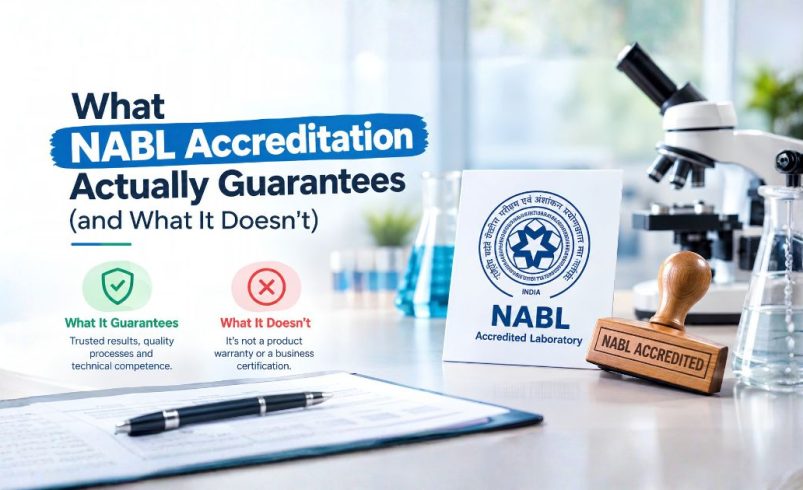
Summary – NABL accreditation provides independent recognition that a conformity assessment body has demonstrated technical competence against applicable accreditation requirements within a defined scope. For businesses looking for NABL Accredited Testing Services, this can provide greater confidence in a laboratory’s testing capabilities, methods, and quality systems. However, NABL accreditation does not mean every test performed by a laboratory is accredited, every result is guaranteed to be error-free, or that the laboratory automatically has every regulatory approval required to operate.
When a company needs a product tested, a material analyzed, or a measurement verified, choosing the right laboratory matters. A test report may influence product quality, procurement decisions, manufacturing processes, regulatory submissions, or customer acceptance.
That is why terms such as NABL accredited laboratory, NABL testing laboratory, and NABL Accredited Testing Services often appear when businesses compare testing providers.
But what does NABL accreditation actually tell you?
More importantly, what does it not tell you?
What Is NABL Accreditation?
The National Accreditation Board for Testing and Calibration Laboratories (NABL) provides third-party accreditation to conformity assessment bodies, including testing and calibration laboratories, medical laboratories, proficiency testing providers, reference material producers, and biobanks under applicable standards.
For testing laboratories, accreditation is generally based on ISO/IEC 17025, which focuses on laboratory competence and the ability to consistently perform testing and calibration activities.
In simple terms, NABL accreditation is independent recognition that a laboratory has demonstrated competence for specific activities within its accredited scope.
Is NABL Accreditation the Same as ISO Certification?
No.
An ISO certification generally relates to an organization’s management system against a particular ISO standard. NABL accreditation, on the other hand, is concerned with the technical competence of a conformity assessment body for defined activities.
This distinction is important when someone is searching for a NABL accredited testing laboratory. An organization having an ISO certificate does not automatically mean that all of its laboratory testing activities are NABL accredited.
What Does NABL Accreditation Actually Guarantee?
The word “guarantee” needs some care here.
NABL states that accreditation signifies conformity with applicable accreditation criteria and recognition of management-system conformity and technical competence at the time of assessment. It specifically states that accreditation is not an endorsement, warranty, or guarantee of a laboratory’s individual test or calibration results or continued performance.
So, what practical confidence does accreditation provide?
1. Demonstrated Technical Competence
A NABL assessment examines whether a laboratory has the technical capabilities and relevant systems required for the activities within its accreditation scope.
For example, a manufacturing company may need a particular material characteristic tested before approving a supplier. The laboratory’s accreditation can provide evidence that the relevant testing capability has been independently assessed.
2. A Defined Testing Capability
NABL accreditation is scope-specific.
The scope identifies the activities for which the laboratory is accredited. NABL explains that laboratories operating across multiple disciplines may need accreditation for the relevant disciplines separately.
This means “the laboratory is NABL accredited” is only the starting point.
The more useful question is:
Is the exact test I need included in the laboratory’s current NABL scope?
3. Controlled Testing Methods and Processes
Competent laboratory testing depends on more than having sophisticated equipment.
Methods, personnel, equipment, measurement processes, quality controls, records, and technical procedures all matter. NABL’s assessment framework is designed to evaluate technical competence against applicable requirements.
For businesses purchasing NABL Accredited Testing Services, checking the actual scope and applicable test method is therefore more meaningful than relying only on an accreditation logo.
4. Ongoing Compliance
Accreditation is not simply a one-time inspection followed by permanent approval.
NABL requires accredited conformity assessment bodies to demonstrate continuing conformity and competence within their accredited scope. Current NABL information states that the accreditation validity was increased from two years to four years, with yearly onsite surveillance and reassessment every two years.
This continuing assessment helps maintain confidence that the laboratory continues to meet applicable requirements.
What Does NABL Accreditation NOT Guarantee?
This is where many businesses misunderstand laboratory accreditation.
It Does Not Mean Every Test Is NABL Accredited
A laboratory can offer several testing services while having NABL accreditation for only specific activities.
For example, imagine a laboratory performs 50 different tests but its accredited scope covers only 20. The remaining tests should not automatically be described as NABL accredited simply because the laboratory itself holds NABL accreditation.
Always check the current scope.
It Does Not Mean Every Result Is Automatically Error-Free
NABL accreditation is not a promise that every individual test result will be perfect.
NABL’s current terms explicitly state that accreditation does not constitute a warranty or guarantee of test or calibration results, services, or continued performance.
A technically competent laboratory can still encounter a sample problem, measurement variation, instrument issue, or other situation that requires a thorough Geotechnical Investigation.
It Does Not Automatically Mean Regulatory Approval
NABL accreditation and regulatory approval are different things.
NABL’s current terms state that accreditation does not replace applicable laws, regulations, licenses, registrations, permissions, or statutory requirements unless accreditation is specifically mandated by the relevant authority.
For industries such as food, pharmaceuticals, healthcare, construction, environmental monitoring, and manufacturing, additional regulatory requirements may apply.
It Does Not Approve the Entire Organization for Everything
Accreditation applies to defined activities, locations, and scopes.
A business should therefore avoid interpreting a NABL certificate as blanket approval of every laboratory service, facility, branch, product, or technical activity operated by an organization.
How Does NABL Assess a Laboratory?
The accreditation process involves assessment against applicable requirements.
At a practical level, a laboratory seeking accreditation identifies its required scope, prepares its systems and technical capabilities, undergoes assessment, addresses identified non-conformities where applicable, and receives an accreditation decision.
After accreditation, continued compliance is monitored through surveillance and reassessment activities. NABL also uses trained technical assessors with relevant technical knowledge and experience for laboratory assessments.
This is why accreditation should be viewed as an ongoing competence and conformity framework rather than a simple certificate purchase.
What Are the Benefits of Using NABL Accredited Testing Services?
For businesses, the practical benefit is greater confidence when selecting a laboratory for defined testing requirements.
A NABL-accredited laboratory can provide independently assessed evidence of competence for activities within its scope. NABL itself describes accreditation as a way of evaluating competence and helping customers identify reliable testing, calibration, proficiency testing, and services that reflect the standards of NABL-Accredited Testing.
This can be particularly relevant when test results support:
- Product quality decisions
- Supplier qualification
- Manufacturing quality control
- Research and development
- Customer specifications
- Procurement requirements
- Regulatory documentation
- Export-related testing
- Calibration and measurement activities
For manufacturers in industrial regions such as Pune and Pimpri-Chinchwad, for example, the exact scope can be important when selecting a laboratory for material, component, environmental, or product testing.
How Can You Verify a NABL Accredited Laboratory?
Before ordering testing, do not rely only on a website statement saying “NABL accredited.”
Instead, verify:
- Current accreditation status
- Accreditation certificate number
- Validity
- Laboratory or facility location
- Exact accredited scope
- Relevant test or measurement
- Applicable test method or standard
- Any additional regulatory requirement affecting your industry
NABL publishes accreditation information and maintains documentation covering accreditation scopes and requirements.
A simple scope check can prevent an expensive misunderstanding later.
What About International Recognition?
NABL has Mutual Recognition Arrangement (MRA) relationships with international accreditation organizations for specified accreditation programs. These arrangements can facilitate acceptance of test and calibration results between countries represented by participating MRA partners.
However, international recognition should not be interpreted as automatic acceptance of every report in every country.
Exporters should still check the requirements of the destination market, customer, regulator, or certification body.
What Should You Ask Before Choosing NABL Accredited Testing Services?
Before sending samples to a laboratory, ask a few straightforward questions:
Is the exact test included in your current NABL scope?
Which test method or standard will be used?
Does the accreditation apply to this specific facility?
Is the report required for a particular regulator, customer, or export market?
Are there sampling, storage, transportation, or reporting requirements I need to follow?
These questions are often more useful than simply asking, “Are you NABL accredited?”
The Practical Takeaway
When choosing NABL Accredited Testing Services, the most important thing is not simply whether a laboratory displays a NABL accreditation claim.
Look at what is accredited, where it is accredited, which test method is covered, whether the accreditation is current, and whether the report meets your specific regulatory or customer requirement.
That distinction turns NABL accreditation from a marketing label into something you can actually evaluate.
If you need help identifying the right laboratory, understanding an accreditation scope, or determining what testing documentation your business requires, speak with a qualified testing and compliance professional before proceeding. A clear understanding of the required test, applicable standard, and accreditation scope can save time, avoid repeat testing, and make the final report much more useful.
Frequently Asked Questions
What does NABL accreditation actually mean?
NABL accreditation means that a conformity assessment body has been independently assessed against applicable accreditation requirements and recognized as technically competent for defined activities within its accredited scope.
Does NABL accreditation guarantee accurate test results?
No. NABL accreditation does not guarantee that every individual test result will be error-free. It provides recognition of technical competence and conformity with applicable requirements within the accredited scope.
Does NABL accreditation cover every test performed by a laboratory?
No. NABL accreditation is scope-specific. A laboratory may perform tests outside its accredited scope, so customers should verify whether the exact test they require is included in the current scope.
How can I verify whether a laboratory provides NABL Accredited Testing Services?
Check the laboratory's current NABL accreditation status, certificate details, facility, validity, and most importantly, the specific accredited scope covering the test you need.
What is the difference between NABL accreditation and ISO certification?
NABL accreditation focuses on independently assessed technical competence for defined conformity assessment activities. An ISO certification generally addresses conformity of an organization's management system to a particular ISO standard. They are related concepts but are not interchangeable.