



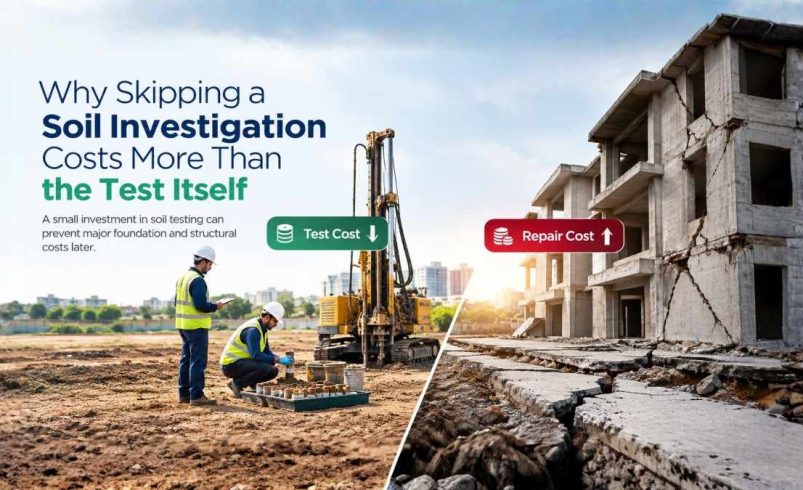
Summary – A soil investigation identifies the ground conditions beneath a construction site before foundation work begins. It helps engineers understand soil strength, bearing capacity, groundwater, settlement risk, and subsurface layers. Skipping this step may save money initially, but unexpected soil problems can lead to foundation repairs, redesigns, delays, and significantly higher construction costs.
The Cheapest Construction Decision Can Become the Most Expensive
When planning a construction project, it is natural to look for areas where costs can be reduced. Soil investigation is sometimes treated as one of those expenses.
That can be a costly mistake.
A building does not stand on drawings alone. Its foundation transfers structural loads into the ground, so the quality and behaviour of that ground directly influence the safety and performance of the structure.
If the soil is weaker than expected, contains uncontrolled fill, has a high groundwater table, or changes significantly with depth, a foundation designed on assumptions may not perform as intended.
The important question is therefore not simply, “How much does soil testing cost?”
A better question is, “What could it cost if the soil conditions are wrong?”
What Is a Soil Investigation?
A soil investigation is a systematic examination of subsurface ground conditions at a construction site.
It may involve field investigation, boreholes, trial pits, soil sampling, Standard Penetration Tests (SPT), groundwater observations, and laboratory analysis. The findings are then used to prepare a geotechnical or soil investigation report.
The objective is straightforward: give engineers reliable information about the ground before important foundation and construction decisions are made.
Depending on the project, investigation may help determine:
- Soil classification and layering
- Bearing capacity
- Soil density and strength
- Settlement characteristics
- Groundwater conditions
- Depth of competent strata
- Suitability of foundation systems
- Excavation and earthwork considerations
This information turns an uncertain site into a more predictable engineering problem.
What Happens When You Skip Soil Investigation?
The biggest risk is not that something will definitely go wrong. The risk is that you are making important decisions without knowing what lies beneath the surface.
1. Foundation Design May Be Based on Wrong Assumptions
A foundation must be appropriate for the actual ground conditions. Since foundation design depends on soil investigation, engineers need reliable information about soil strength, bearing capacity, and subsurface conditions before finalizing the foundation system.
If engineers assume stronger soil than what exists, the foundation may not have the required capacity. This can result in excessive settlement, cracking, or structural distress.
Correcting such problems after construction is much more complicated than investigating the soil beforehand.
2. Differential Settlement Can Cause Visible Damage
Different parts of a building can settle at different rates when the underlying soil conditions vary.
Early signs may include:
- Cracks in walls
- Uneven floors
- Gaps around doors and windows
- Cracks near foundations
- Distortion in structural elements
The severity depends on the building, soil conditions, foundation system, and other factors, but the underlying lesson is consistent: unexpected ground movement is expensive to manage after construction.
3. Groundwater Can Create Unexpected Problems
Groundwater is another factor that cannot be reliably judged just by looking at the site surface.
Unexpected groundwater can affect excavation, basement construction, dewatering requirements, drainage planning, and construction schedules.
A proper site investigation can provide useful information about groundwater conditions and help the project team plan accordingly.
4. Construction Can Slow Down
Imagine a contractor starts excavation and discovers a weak or unexpected soil layer.
The project may suddenly require additional investigation, engineering review, design modifications, soil replacement, stabilization, or a different foundation approach.
Every change can affect labour, equipment, materials, approvals, and project schedules.
How Does Skipping Soil Testing Increase Construction Costs?
The financial impact often develops through a chain reaction:
Skipped investigation → incorrect assumptions → unsuitable design → construction problem → redesign → delay → additional work → higher project cost
The original soil investigation might have been a controlled and relatively predictable expense.
The resulting repair can be much less predictable.
Potential additional expenses may include:
- Additional excavation
- Soil replacement
- Ground improvement
- Foundation strengthening
- Underpinning
- Dewatering
- Additional concrete and reinforcement
- Engineering redesign
- Equipment rental
- Labour
- Project delays
- Reconstruction
This is why soil investigation should be viewed as a risk-management investment, rather than simply another testing charge.
Can Soil Investigation Prevent Foundation Problems?
It can significantly reduce uncertainty and help engineers make better-informed foundation decisions.
For example, if field testing identifies a weak soil layer at a particular depth, the structural and geotechnical teams can account for that condition during design.
Similarly, information about soil density, bearing capacity, groundwater, and subsurface variability can influence decisions about shallow or deep foundations and other ground-related construction measures.
The investigation does not eliminate every construction risk. Instead, it provides evidence that allows those risks to be assessed before they become expensive problems.
What Soil Problems Can a Proper Investigation Detect?
Ground conditions vary from one site to another, even within the same city.
Depending on the site, investigation and testing may identify conditions such as:
- Soft or loose soil
- Expansive soil
- Highly compressible layers
- Uncontrolled filled ground
- Organic or problematic soil
- Low-bearing-capacity strata
- Variable soil profiles
- High groundwater
- Weak layers below stronger surface material
This is particularly important when the site has a complicated history or previous development.
How Does Soil Investigation Help With Foundation Design?
Foundation design depends heavily on how the ground responds to structural loads.
Soil investigation provides data that can help engineers evaluate:
Soil properties → bearing capacity → settlement risk → foundation requirements
Depending on the findings and structural requirements, engineers may consider solutions such as isolated footings, strip footings, raft foundations, piles, or other suitable foundation systems.
The correct choice should always be based on project-specific engineering assessment rather than assumptions or a one-size-fits-all approach.
Why Is a Geotechnical Report Important?
Testing alone is not the end of the process.
The results need to be interpreted and communicated clearly through a geotechnical or soil investigation report.
A useful report can include information about:
- Borehole and investigation locations
- Soil strata
- Field test results
- SPT values where applicable
- Laboratory test results
- Groundwater observations
- Bearing capacity recommendations
- Settlement considerations
- Foundation-related recommendations
- Excavation considerations
For project owners and contractors, the report provides a technical reference for making informed construction decisions.
Why Choose Field Soil Testing Laboratory Services in Pune?
For projects in Pune and surrounding construction areas, site-specific investigation is especially valuable because ground conditions can vary from one location to another.
Developers, contractors, structural consultants, and property owners can consider professional Field Soil Testing Laboratory Services in Pune when they need field investigation, soil sampling, SPT testing, laboratory soil analysis, bearing capacity assessment, groundwater evaluation, and geotechnical reporting.
Local projects across Pune, Pimpri-Chinchwad and developing areas can involve different site conditions, construction types, and foundation requirements. That makes it important to investigate the actual site rather than relying on assumptions from a neighbouring property.
For construction professionals, field data combined with laboratory soil testing provides a stronger technical basis for foundation and site-development decisions.
When Should Soil Investigation Be Done?
Ideally, soil investigation should be completed before final foundation design and major construction decisions.
It can be particularly important for:
- Residential buildings
- Commercial developments
- Industrial projects
- Multi-storey structures
- Infrastructure projects
- Road and civil construction
- Retaining structures
- Sites with filled or disturbed ground
- Projects where groundwater may be an issue
The earlier the ground conditions are understood, the more options the project team has to respond to them.
Is Soil Investigation Necessary for Small Projects?
Project size alone does not determine ground risk.
A smaller building can still encounter weak soil, variable ground conditions, filled land, or groundwater. The appropriate level of investigation depends on factors such as structural loads, site conditions, building type, local requirements, and professional engineering judgment.
For property owners, spending on appropriate investigation before construction can be far more practical than discovering a foundation problem after the building is completed.
A Simple Example: Saving on Testing, Spending on Repairs
Consider a project where the owner decides to skip soil testing to reduce the initial budget.
Construction begins, but excavation reveals unexpected weak soil. The original foundation assumptions now need to be reviewed.
The project may require additional engineering investigation, revised foundation details, extra materials, soil improvement, and construction delays.
The money saved by skipping the investigation can quickly disappear—and the project now has additional uncertainty, cost, and stress.
A soil investigation does not guarantee that every construction problem will be avoided. What it does is provide valuable information before the project commits to expensive decisions.
How Can Builders Reduce Soil-Related Construction Risks?
A practical approach is simple:
- Investigate the site before final foundation decisions.
- Use appropriate field testing based on project requirements.
- Carry out relevant laboratory soil tests.
- Assess groundwater conditions where applicable.
- Have qualified professionals interpret the results.
- Use the findings in foundation and construction planning.
- Keep the soil investigation report available during project execution.
Most importantly, do not select a testing approach solely because it is the cheapest option. The right investigation is the one that provides enough reliable information for the actual project.
Know the Ground Before You Build on It
Soil investigation is not simply a testing formality. It is one of the earliest opportunities to identify ground-related risks before they become construction problems.
The cost of field testing and laboratory analysis is visible at the beginning of a project. The cost of foundation failure, settlement, redesign, delays, or remediation can appear much later—and can be considerably harder to control.
If you are planning construction in Pune or Pimpri-Chinchwad, do not make foundation decisions based only on assumptions or surface observations. Get the ground investigated, understand the soil data, and let qualified professionals use that information to guide the project.
Before excavation and foundation work begin, consult a reliable testing laboratory for the appropriate field soil testing, geotechnical investigation, laboratory analysis, and reporting required for your site. A relatively small investment in understanding the ground today can prevent a much larger construction expense tomorrow.
Frequently Asked Questions
Is soil investigation really necessary before construction?
Yes. Soil investigation helps identify soil strength, bearing capacity, groundwater conditions and settlement risks before foundation work begins. This information helps engineers make better foundation and construction decisions and reduces the chance of costly surprises later.
What happens if you skip soil testing before building?
Skipping soil testing can lead to incorrect foundation assumptions, unexpected weak soil, settlement, redesign, construction delays and additional costs. The problem is not that failure is guaranteed, but that important construction decisions are being made without reliable information about the ground.
Can soil investigation save construction costs?
Yes. Soil investigation is an upfront cost, but it can help prevent much larger expenses caused by unsuitable foundations, soil replacement, ground improvement, redesign, delays or remediation. It is better viewed as a construction risk-management investment rather than just a testing expense.
When should soil investigation be done for a construction project?
Ideally, soil investigation should be completed before final foundation design and major construction decisions. Early investigation gives engineers reliable ground information while there is still time to adjust the foundation or construction approach if unexpected soil conditions are found.
Why are field soil testing services important in Pune?
Field soil testing services in Pune help construction teams understand the actual ground conditions at their site instead of relying on assumptions from nearby properties. Field investigation, soil sampling, SPT testing, laboratory analysis and groundwater assessment can provide useful information for foundation and site-development decisions.